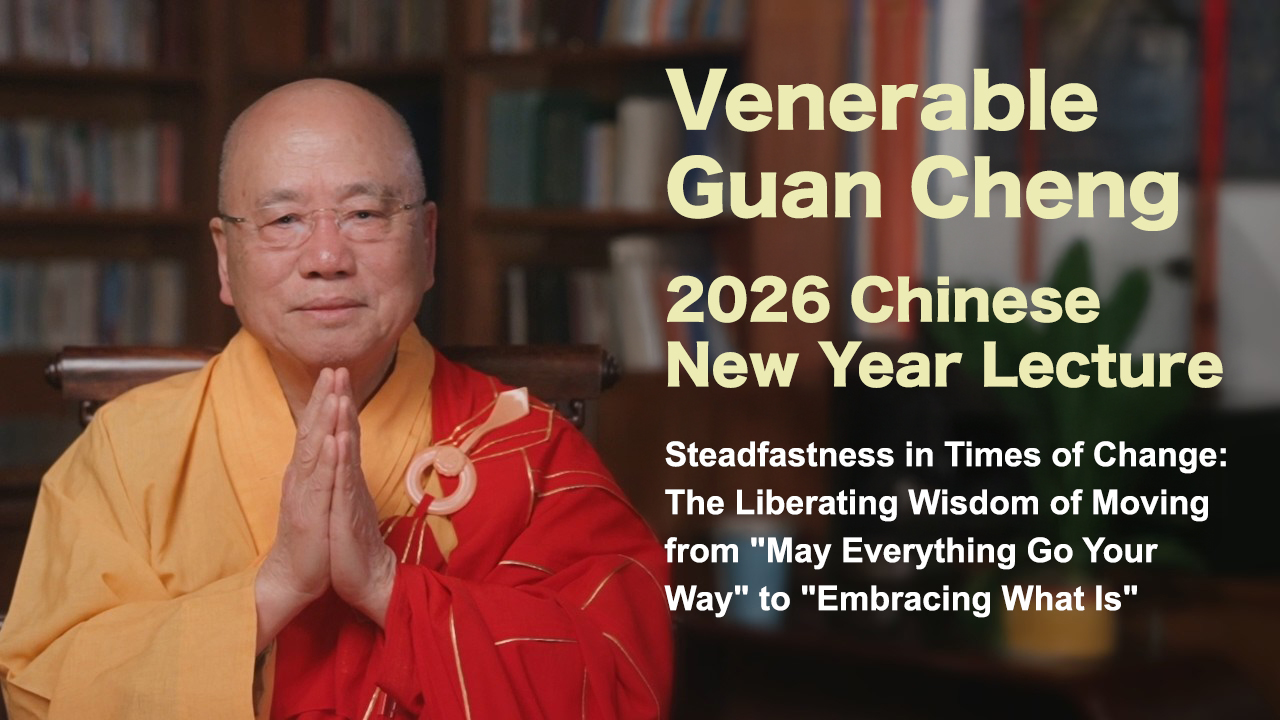
Steadfastness in Times of Change: The Liberating Wisdom of Moving from “May Everything Go Your Way” to “Embracing What Is”
Fellow practitioners and friends,
Happy Chinese New Year 2026! First and foremost, I wish you all the best of health, happiness, and peace in every moment.
When we gather for the New Year, a favourite greeting we share is, “May everything go your way.” Yet, deep down, we all know that over the past few years, Hong Kong has undergone profound changes in both its economy and its way of life. Take our spending habits, for example: where tourists once flocked to our city, locals are now the ones heading across the border to spend, leaving local businesses desolate. Faced with this broader trend of global economic transition, many of us unknowingly carry a deep sense of helplessness and anxiety.
But let us reflect for a moment: beyond the pursuit of wealth, status, and material goods, is there a more stable and enduring happiness in life? The only absolute certainty in this world is that everything changes—Buddhism calls it “impermanence.” Just like the seasons, the vibrant blooms of spring and summer inevitably give way to the quiet cold of autumn and winter. We suffer, often because our hearts are still clinging to the springs of the past. We must understand that while nostalgia is a natural emotion, once it turns into attachment, it becomes a shackle on the mind. The harder you try to grip something that is already changing, the more that resistance will cause you pain.
Buddhism does not teach us to escape reality; instead, it teaches us to stay grounded and find the strength to hold steady amidst change. What is this “steadfastness”? Many assume it simply means sitting motionless. In truth, genuine steadfastness in Buddhism means not being swayed by your circumstances. It means that no matter how the wind and rain batter the world outside, we maintain a pure, undisturbed sanctuary within. Only with this steadfastness can we see things as they truly are.
When we are anxious, our decisions are often flawed. Spiritual practice is about returning to clarity and calm in the face of adversity. As the Zen poem says:
“The waters of a thousand rivers reflect a thousand moons;
without clouds, the sky spans ten thousand miles.”
Only by clearing the clouds from our minds can our innate, pure wisdom shine through. Master Shenxiu also reminds us:
“The body is the Bodhi tree,
the mind is like a clear mirror.
Diligently wipe it at all times,
and let no dust accumulate.”
But the question is: when the pressures of life overwhelm us, how exactly do we wipe the dust from our minds?
Why does Buddhism place such emphasis on “steadfastness” and “wisdom”? Because our current environment is subjecting us to a double blow. The first is the objective reality of the external world. However, the truly fatal blow is the second: our internal landscape, where insecurity breeds negative emotions. Statistics suggest that in Hong Kong, one in five people suffers from emotional distress. Among our youth, 40 out of every 100 secondary school students show severe signs of depression. In the workplace, the threat of layoffs and industry shifts leaves many living in daily fear over their jobs and basic livelihoods. For many elders, the wave of emigration has altered their family structures; left without loved ones nearby, this profound loneliness has made them increasingly vulnerable to depression.
We must acknowledge that without a solution or wise guidance, simply trying to endure on our own is exhausting. We need a practical and effective method of mind cultivation to help us navigate these hardships. The practice of Buddha-name recitation, passed down for over two thousand years, is a supreme method for this. Master Lianchi once said: “When a purifying jewel is cast into muddy water, the water has no choice but to clear; when the Buddha’s name is cast into a chaotic mind, the mind has no choice but to awaken.” In ancient times, before modern filtration, people would stir alum into muddy water so the silt would settle, leaving the water perfectly clear. The Buddha’s name is the alum for our minds, helping our anxieties settle.
Buddhism teaches that “all phenomena are created by consciousness,” categorizing the world into material dharmas and mental dharmas. Science deals with the material dharmas: physical matter, brain structures, and everything visible to the naked eye. Yet, what truly dictates our happiness and suffering are the mental dharmas: our thoughts and consciousness. The reason Buddha-recitation is so effective is that it works directly on the level of mental dharmas.
Our mind is like a vast warehouse—which Buddhism calls the Alaya consciousness—storing the karmic seeds of anxiety and affliction we have accumulated over countless lifetimes. When you practice Buddha-recitation, you are actively planting the pure seeds of the Buddhas into your deepest consciousness. This is the process of “transforming consciousness into wisdom.” As the seeds within your mind become pure, your perspective clarifies and your wisdom grows. This is the power of “the environment transforming according to the mind.”
This transformation of mental dharmas is now being supported by scientific evidence in the material realm. Modern neuroscience has identified a center of fear and affliction in our brains called the amygdala. When we are under stress or clinging to pain, this center becomes hyperactive and fixated. In fact, the amygdala represents our instinct for self-preservation or self-attachment; it is the physical manifestation of the Seventh Consciousness in Buddhist philosophy. While its original purpose is to protect us, its intensely self-centered nature often traps us in endless fear and attachment.
However, our brains contain another region known as the prefrontal cortex. This acts as our “spiritual commander,” responsible for rational thought and emotional regulation. If the amygdala represents our instinct for self-attachment, the prefrontal cortex governs our awakening wisdom. The two operate like a scale. When the amygdala—our center of self-attachment—becomes overstimulated, the prefrontal cortex loses its guiding influence. Conversely, when the prefrontal cortex regains control, the amygdala calms down, and we naturally return to a state of peace.
Yet, we must understand that the prefrontal cortex—our spiritual commander—is actually guided by the Sixth Consciousness, our conscious mind. Among the eight consciousnesses in Buddhism, the Sixth Consciousness is the most active and acute, responsible for all our wholesome and unwholesome actions.
Therefore, when we practice Buddha-recitation, we are training our Sixth Consciousness to maintain right mindfulness. If we do not actively use this conscious mind to transform our thoughts, the prefrontal cortex loses its authority, leaving the amygdala to run rampant. Conversely, if the Sixth Consciousness focuses entirely on the Buddha’s name, it directs the prefrontal cortex to exercise wisdom, which in turn quiets the amygdala. This is the practical process of “transforming consciousness into wisdom.”
Reciting the sacred name of a Buddha or Bodhisattva is, in essence, a recalibration of the brain. The brain cannot simultaneously process two opposing signals. When you focus on Buddha-recitation, every repetition actively engages the prefrontal cortex—your “spiritual commander” responsible for calm and rational thought. Once this “frequency of awakening” is activated, the amygdala, which constantly emits signals of fear and affliction, is forced to quiet down. This process uses the right mindfulness of the Buddha’s name to replace the noise of affliction, ultimately recalibrating our minds.
This resonance is akin to what modern physics describes as quantum entanglement. Although invisible to the naked eye, particles can share a connection that transcends space, even when separated by vast distances. The moment you practice Buddha-recitation, you trigger the innate connection that already exists between you and the Buddhas and Bodhisattvas. When you connect to this profound spiritual network, you are no longer facing life’s challenges alone. You will feel a powerful, compassionate presence protecting you, allowing you to find a deep sense of security even amidst the fiercest storms.
We must understand that change itself is what brings hope. Therefore, we should shift our mindset from wishing that “everything goes our way” to “embracing what is.” What does this mean? It means having the courage to accept reality. Why must we do this? Because only when you stop fighting reality do you create the space to appreciate every moment of life.
As the famous poem by the Song dynasty Zen Master Wumen Huikai goes:
“Spring has its flowers, autumn its moon;
summer has cool breezes, winter its snow.
When no idle thoughts obstruct your mind,
it is a good season in this world.”
When “idle thoughts” clutter our minds, we become restless and constantly anxious, unable to find peace. This poem reminds us that we cannot control our environment—whether it is spring or winter—but as long as our minds do not resist our circumstances, no matter how difficult the days may be, every season can be a good season.
In truth, as long as our six sense organs (eyes, ears, nose, tongue, body, and mind) are intact and our basic needs are met, we already have every reason to be grateful. The Buddha imparted a profound teaching in The Sutra of the Buddha’s Bequeathed Teaching: “A contented person, even while sleeping on the ground, feels at peace; a discontented person, even while living in heaven, remains dissatisfied.”
This sutra tells us that true peace does not come from where you live or how much money you make, but from whether you know how to be content. If you lack contentment, even heaven would leave you feeling unfulfilled. Genuine happiness never needs to be sought externally. By returning to the present moment and cultivating contentment, our minds will experience true wealth.
Finally, I would like to offer you two “red packets” for the New Year. While they do not contain money, they will help you find something far more valuable in this changing world: inner peace.
The first red packet is a mind dharma:
Always remember to “be in harmony with circumstances as they arise, and abide in the present moment.” We do not speak of stabilizing the “self,” because self-attachment is often the root of affliction. Instead, we must practice accepting unchangeable realities, regardless of how our external environment shifts. We focus on transforming our own consciousness to adapt to the present moment. This is what it means to live in the present.
The second red packet is a daily practice:
Spend 15 minutes every day on recalibrating your mind. Upon waking, many people immediately reach for their phones to check messages or world news. Doing this instantly “downloads” external anxieties and negativity straight into your brain. Starting tomorrow, I suggest setting aside 15 minutes each day for a complete mental recalibration. This practice consists of three five-minute segments and can become your most anticipated daily spiritual recharge.
The first five minutes: Relax and purify. There is no need to rush out of bed. Sit quietly on the edge of the bed, relax your shoulders, and focus on your breath. Calm your mind and silently tell yourself: “I am purifying my mind; let my heart return to peace.”
The second five minutes: Connect with the Buddhas and Bodhisattvas. Imagine your mind logging into a cloud network of compassion and wisdom. The compassionate light of the Buddhas and Bodhisattvas shines upon you like warm sunlight. In this moment, you are no longer fighting alone; you are linked to a boundless energy of wisdom.
The third five minutes: Purify the mind through Buddha-recitation. With a gentle smile, peacefully recite the sacred name, “Namo Amitabha Buddha” or “Namo Avalokitesvara Bodhisattva.” Each recitation plants a powerful seed of peace in your mind, completely clearing away the residual seeds of anxiety and affliction from the night before.
Remember to practice these three five-minute segments every day. Why is this necessary? Because these 15 minutes help you build a mental protective shield. Once you successfully connect, when you step out the door and face traffic, pressure, or any other adversity, your brain will not so easily erupt in agitation. Furthermore, remember that this practice is not just for when you wake up. At any time and in any place, whenever you feel the need, you can silently recite the sacred name. Even if it is just for three or five minutes, it can instantly connect you to the energy of the Buddhas and Bodhisattvas.
Dear readers, external challenges may remain, but our consciousness can change. In other words, while we cannot change the outside world, we can transform ourselves. More importantly, we are not fighting alone. Buddhism speaks of “sympathetic resonance.” When we are willing to take the first step and recite the sacred name, the “external-power” blessings of the Buddhas and Bodhisattvas will unite with our own aspirations, multiplying our steadfastness and wisdom.
You may recite the sacred name of Amitabha Buddha or Avalokitesvara Bodhisattva at any time. Amitabha Buddha blesses sentient beings with longevity and wisdom, while Avalokitesvara Bodhisattva is revered for “answering a thousand prayers from a thousand places, ever a ferryboat across the sea of suffering.” As long as we hold firmly to the “life preserver” of their sacred names and rely on their compassionate vows, no matter how the world changes, we will possess the deepest sense of security within our hearts.
Finally, I once again offer you my best wishes for the New Year: May you find peace in all circumstances, and may your hearts be filled with constant joy! Namo Amitabha Buddha!
