Praying for Hong Kong’s prosperity and the elimination of natural disasters and epidemics
Translated by: Tony Qin
Article by: Wong Pui-yan
Photos: Raymond / Some images courtesy of the interviewees, with thanks.
Due to the global pandemic, Venerable Guan Cheng had been unable to return to Hong Kong for nearly six years. In 2024, when he finally returned, he saw that the city’s economy had yet to recover, and that many industries were still facing great difficulty.
In response to these changes in the broader economic climate, Venerable Guan Cheng gave rise to a compassionate vow. He hoped to hold a large-scale Dharma assembly to dispel calamities and bring blessings, gathering a thousand people to focus together on sutra recitation. United in purpose, they would pray for harmony in Hong Kong society, for prosperity and stability, for the health of the people, and for the removal of natural disasters, epidemics, and human suffering.
Finding a venue that could hold more than a thousand people was not easy. Preparations began a year in advance, and in the end MacPherson Stadium, which can accommodate over a thousand participants, was secured. Monastics from Mainland China, Taiwan, Hong Kong, and Malaysia were invited to come together to bring the Dharma assembly to a harmonious fruition.
Throughout the process, everyone acted with a spirit of equality and selflessness. The Dharma assembly accepted no monetary offerings. To prevent seats from being reserved without attendance, a HK$100 seat-reservation deposit was introduced, which would be returned at the end of the assembly. If any participant chose not to reclaim it, the full amount was donated to the Tung Wah Group of Hospitals. United in heart and purpose, everyone worked together to bring the assembly to fruition, to benefit sentient beings, and to make a truly meaningful contribution.
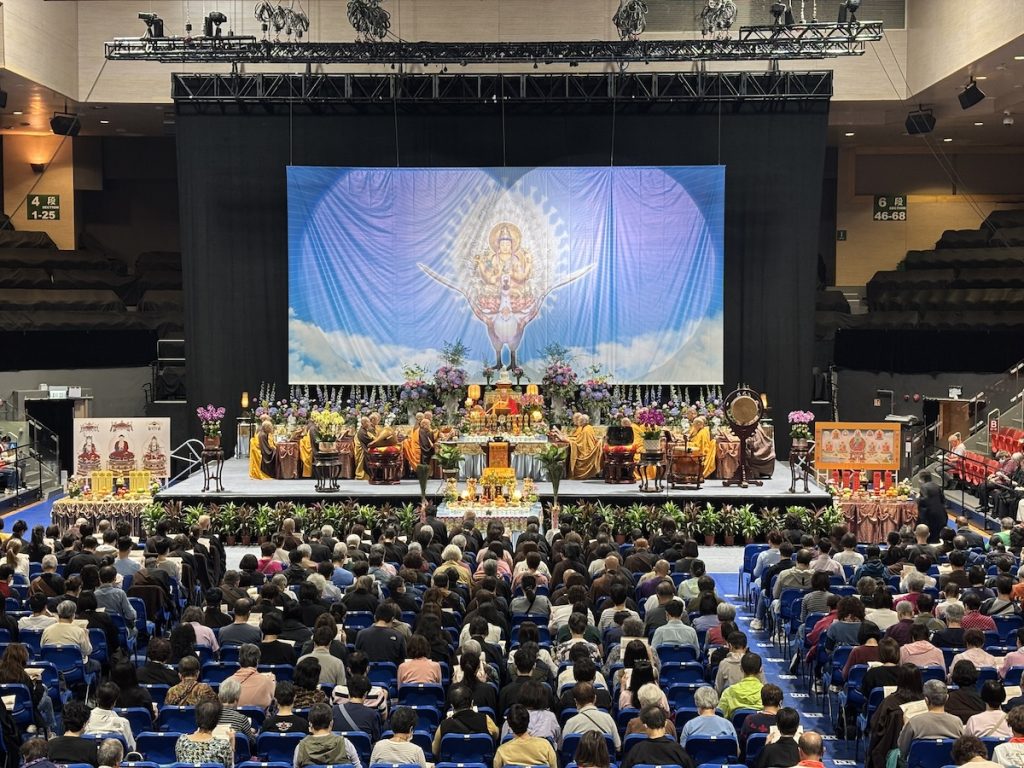
From November 15 to 17, 2025, the International Buddhist Society and the Precept Concentration Wisdom Lecture Hall jointly held the Thousand-Person Sutra Recitation and Blessing Dharma Assembly of the Buddha Mother Great Golden Radiance Peacock Wisdom King Sutra. Venerable Guan Cheng presided over the assembly together with monastics from various temples.
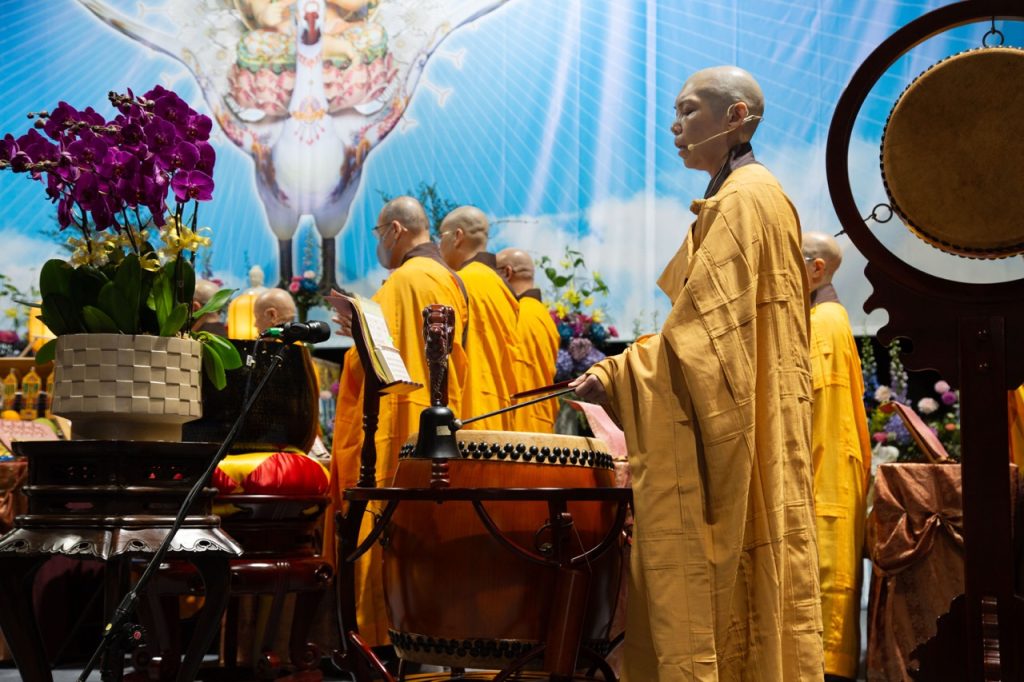
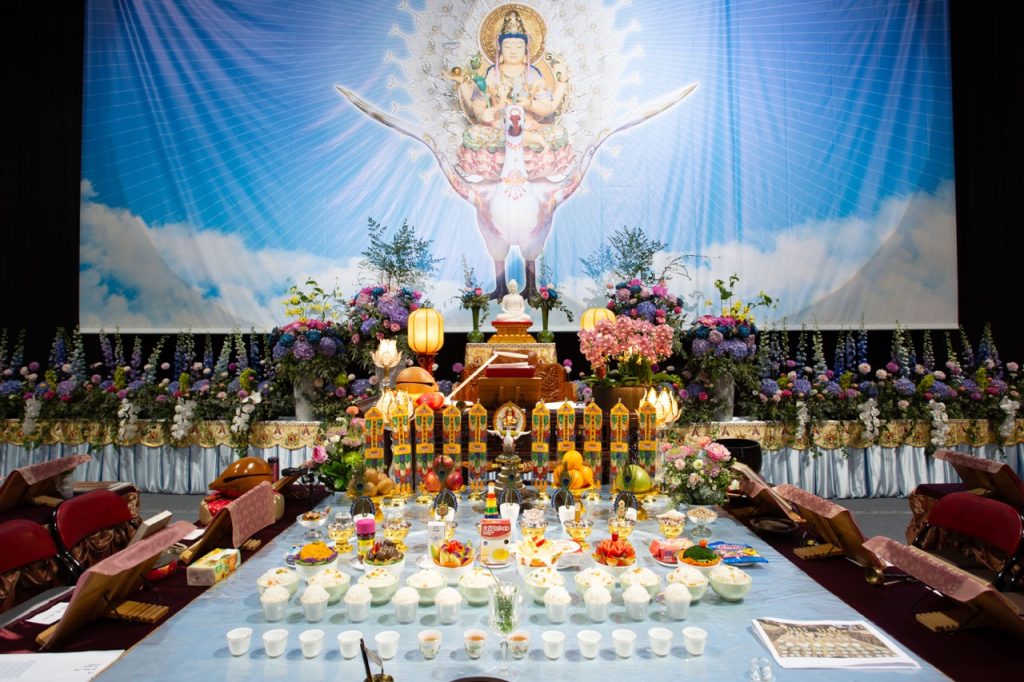
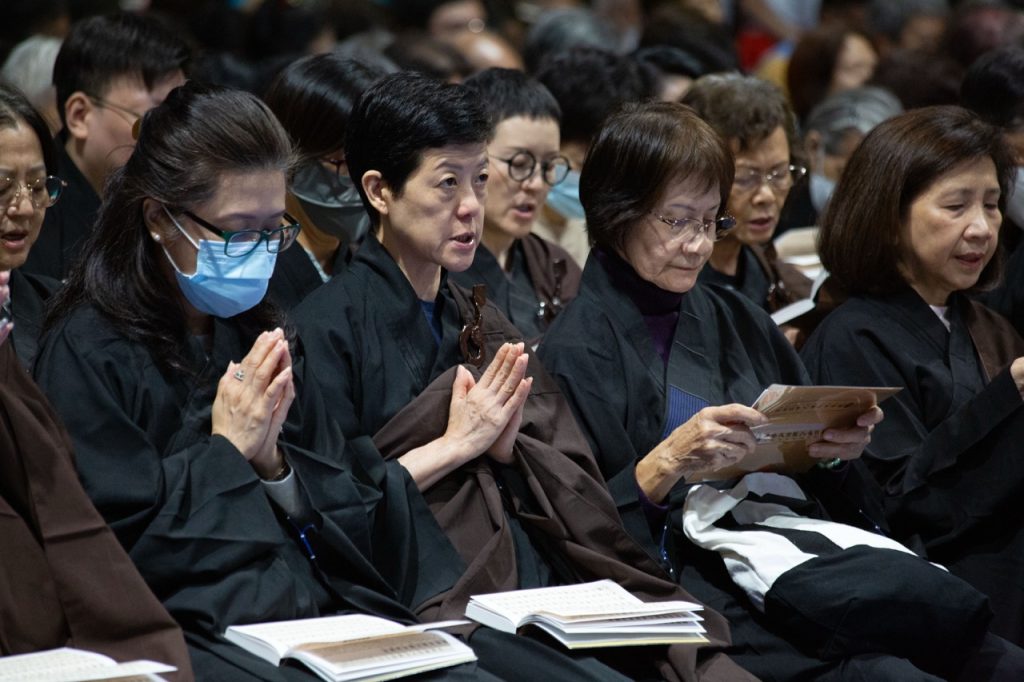
Over the three days, more than a thousand people attended each day. The venue was arranged into colour-coded sections around the hall, with additional seating placed in the center, all facing the main stage. A large image of the Peacock Wisdom King hung at the front. Upon seeing the compassionate presence of the Wisdom King and the peacock’s radiant feathers, a sense of loving-kindness naturally arose. Large screens on both sides of the hall allowed everyone to contemplate the image while reciting the sutra, and amid the rising and falling voices of chanting, the atmosphere was deeply moving and focused.
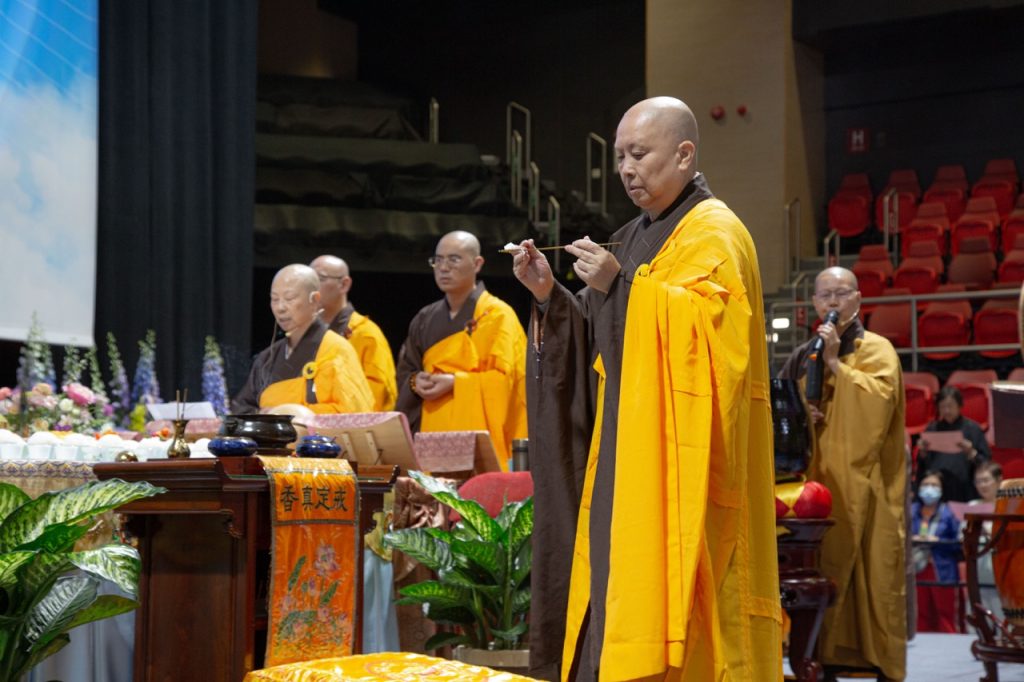
The front of the hall was arranged with solemn dignity. Offerings were placed on the altar according to classical texts and traditional practice. Beneath the main altar were three subsidiary altars: the central Dragon King Altar (Brahma Altar), with a Longevity Altar on one side and a Rebirth-Transference Altar on the other.
Volunteers worked diligently to maintain order, and entry and departure were calm and well organized. At midday on the second day, benefactors provided vegetarian boxed meals and water for lunch, which everyone enjoyed in silence.
The Meaning of the Ritual Objects Held by the Peacock Wisdom King:
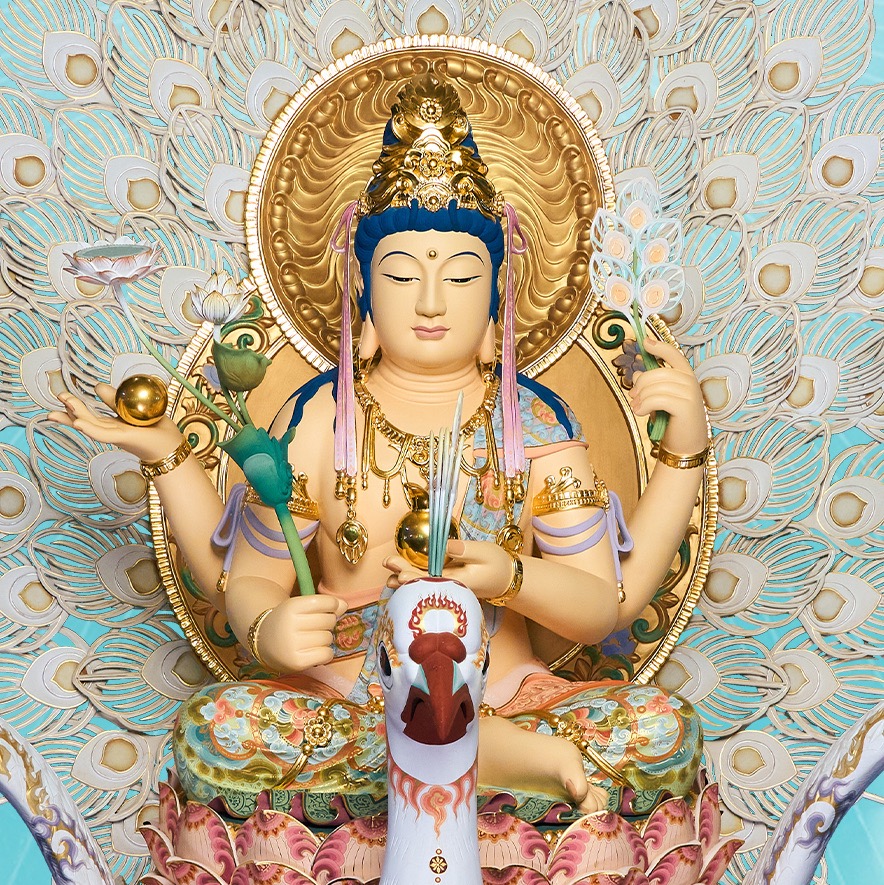
The Buddha Mother Great Golden Radiance Peacock Wisdom King Sutra is one of the three major disaster-averting, nation-protecting scriptures of East Asian Esoteric Buddhism, and one of the four great esoteric Dharma methods of the Shingon tradition. It possesses the virtues of removing karmic obstacles, awakening wisdom, clearing physical and mental afflictions, and dispelling natural and human-made calamities.
This sutra’s defining feature is that “sincere recitation is always answered with blessings.” Through this Dharma assembly, prayers were offered for harmony in Hong Kong society, for prosperity and peace in all walks of life, and for the cessation of natural disasters and epidemics throughout the world.
When this sutra is recited, the twenty-eight classes of spirits are invited to join in the chanting. Through the compassionate power of the Buddha-Dharma, even ghostly beings are embraced and become protectors of the Dharma. The peacock itself offers a fitting metaphor: it consumes poisonous plants and insects without harm, and its feathers grow ever more radiant as a result. This symbolizes the sutra’s power to neutralize poisons—removing the three poisons of greed, anger, and delusion, along with the afflictions they give rise to.
This sutra contains more than thirty mantras, many of them quite long. As most people were not familiar with them, it was not always easy to keep pace. During recitation, some did not chant aloud, while others found it hard to stay focused. Seeing this, Venerable Guan Cheng gently offered this encouragement and guidance:
“Focus your mind and form the mudra. Recite with one-pointed attention. Use your heart to feel the movement with your whole awareness. Chant with utmost sincerity—whether for yourself or for others. Each line recited gives rise to energy. With sincere intention, this energy will radiate to all sentient beings and fill the entire MacPherson Stadium!”
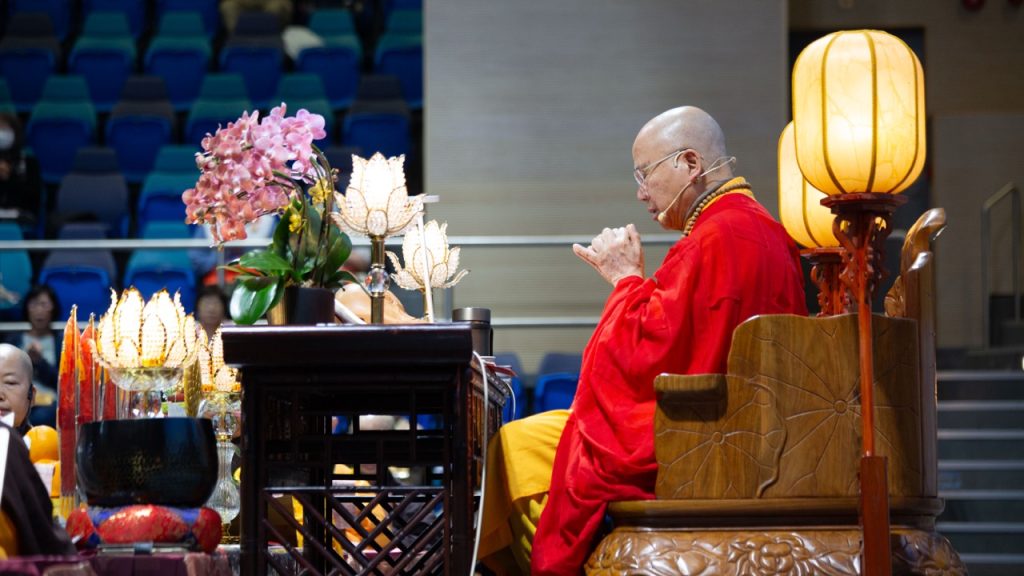
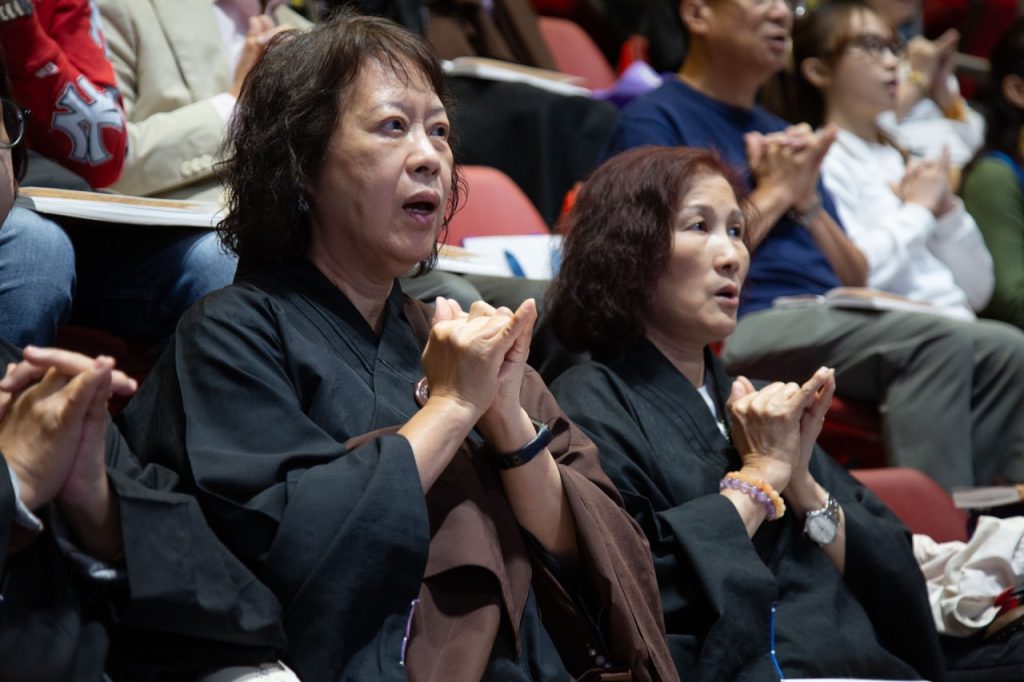
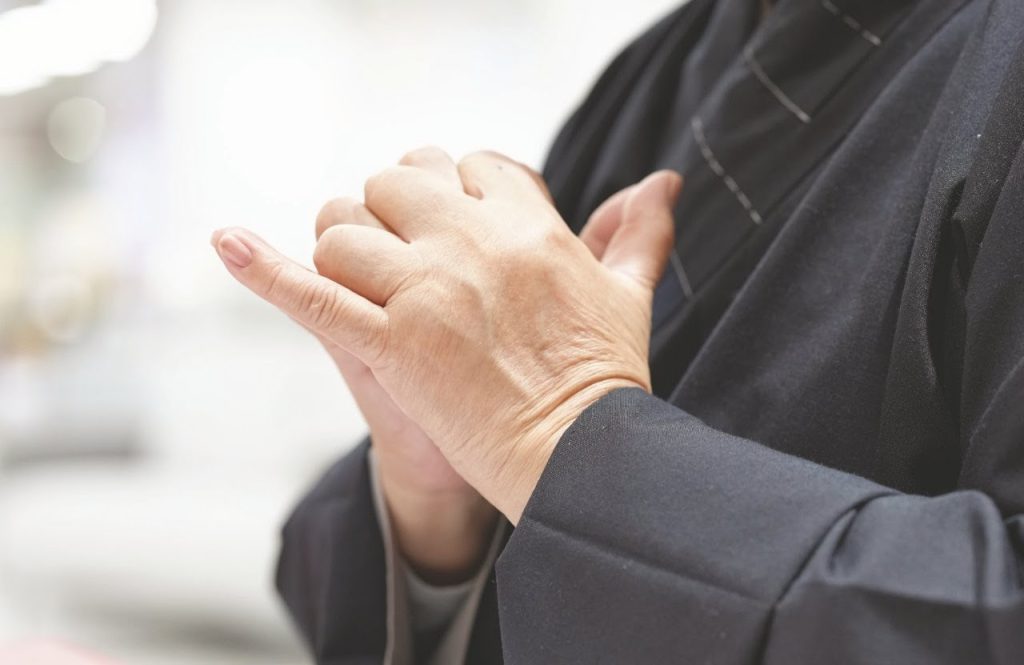
By forming the mudra with sincerity, placing the palms together at the chest, and voicing the mantra with heartfelt presence, the resulting sound is imbued with energy. When voices rise and fall together, this resonance creates great strength. As our minds easily become scattered, we were encouraged to rest our gaze on the large image of the Peacock Wisdom King behind us, to imprint it in our minds, and to recite the mantra with the wish that all sentient beings—throughout Hong Kong, China, and across the world—may experience compassion, joy, and benefit.
This force arises from the depths of each person’s heart and radiates outward—to family, friends, and all sentient beings. It helps relieve physical pain and toxins, reduce afflictions, clear karmic obstacles, and support health and longevity, with heavy past karma transformed into lighter burdens. After Venerable Guan Cheng’s guidance, the atmosphere of the Dharma assembly became even more focused as everyone recited the sutras and mantras with single-minded unity.
Sutra and mantra recitation has the power to dispel calamities and remove obstacles—most importantly, it neutralizes the three poisons of greed, anger, and delusion within the mind. Sentient beings suffer, and the root of that suffering lies in our attachments. When we visualize the Peacock Wisdom King, we encounter a form that is compassionate and dignified, unlike the wrathful appearances of other Wisdom Kings. Gazing upon the Peacock Wisdom King and the peacock’s radiant feathers, the mind naturally gives rise to compassion.
In addition to upholding compassion and the removal of poisons and misfortune, what is especially distinctive about the Peacock Wisdom King Sutra is that it sincerely invites Bodhisattvas, benevolent spirits, tree spirits, mountain spirits, sea spirits, Dragon Kings, and even yakshas and rakshasas to recite together and offer protection.
On the first two days, one full recitation of the Buddha Mother Great Golden Radiance Peacock Wisdom King Sutra was completed each day, with the wish to benefit all sentient beings, so that those living might receive blessings of disaster relief, extended life, and the removal of obstacles. On the final evening, a Mengshan Feeding of Hungry Ghosts Dharma Assembly was held, dedicating all the merit of sutra recitation to all beings, including those who had passed away, in the hope that they might attain liberation.
Venerable Guan Cheng also offered approachable explanations of selected passages from the sutra, helping everyone better understand and engage in the recitation.
The Protective Power of the Sutra and Mantras
The sutra states:
“Ananda! There are ghostly beings, humans and non-humans; all kinds of harmful evils, misfortunes, and illnesses; all kinds of ghosts and spirits, messengers, hostile enemies, fears and terrors; all kinds of poisons, curses, and harmful rites—none of these can violate or overcome the Buddha Mother Great Peacock Wisdom King. Removed from unwholesome actions, one attains great auspiciousness, receives the blessings of all sages, and has one’s wishes fulfilled.
Furthermore, Ananda! If a person recites the name of the Buddha Mother Great Peacock Wisdom King, they will protect both themself and others. One may also tie consecrated threads and wear them on the body…”
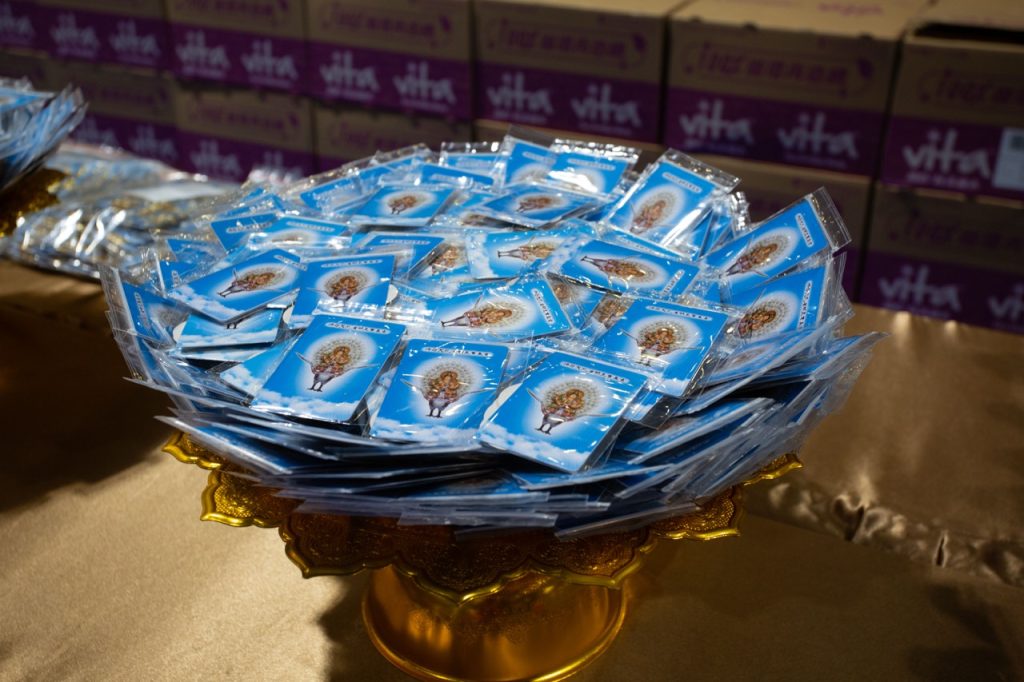
Reciting the sutras and mantras of the Buddha Mother Peacock Wisdom King enables all sentient beings—including ghosts and non-humans—to stay far from misfortune, such as illness, harmful spirits, poisons, and curses. Through sincere recitation, one’s wishes may be fulfilled, and protection extends to oneself as well as to family and friends. During recitation, consecrated threads may be worn on the body, and in daily life they may also be carried for ongoing protection.
Humans, Devas, and Spirits All Uphold This Mantra
The sutra states:
“Devas, asuras, yakshas, and others who come to hear the Dharma should give rise to utmost sincerity, protect the Buddha-Dharma so that it may long endure, and each diligently practice the teachings of the World-Honoured One.
All who come to listen—whether dwelling on the earth or abiding in the sky—should continually give rise to compassion in the human world and abide by the Dharma day and night.
May all worlds always be peaceful and secure, may boundless blessings and wisdom benefit all beings, may all karmic offenses be eliminated, and may all be freed from suffering and return to perfect serenity.”
Regular recitation of the Peacock Wisdom King mantra brings blessings, helping to dispel calamities and remove obstacles. Those who come to hear the Dharma include both primary and dependent results: humans are the primary result, while tree, mountain, and river spirits—and the great earth—are the dependent result. Humans, devas, and spirits alike uphold and recite this mantra. Not only benevolent spirits recite it—even malevolent spirits and ghosts do so, transforming harmful intentions into wholesome ones. By consistently practising compassion, joy, equanimity, and acts that benefit all sentient beings, the power of this mantra can manifest more fully.
-1024x682.jpeg)
Heavy Offenses Lightly Repaid
The sutra states:
“…If a person were destined for the death penalty, it may instead be resolved through the payment of a fine; if they were to be punished by a fine, it may be resolved through light beating; if they were to be lightly beaten, it may be resolved through harsh words; if they were to be harshly reprimanded, it may naturally be resolved. All suffering and hardship will completely disperse.”
How can heavy offenses be repaid lightly? Through repentance and sincere recitation of the mantras. What should have resulted in death may instead be resolved through compensation; what required compensation may be resolved through physical hardship; what involved physical punishment may be resolved through harsh words; and what involved harsh words may be resolved through gentle admonition. In this way, one is naturally released, and worries and afflictions gradually dissolve.
This passage reminds us that through mindful recitation, heavy karmic retribution can become lighter. Only through diligent repentance and earnest practice can karmic obstacles be removed and fear brought to an end.
The Peacock Dharma Mandala at the Assembly
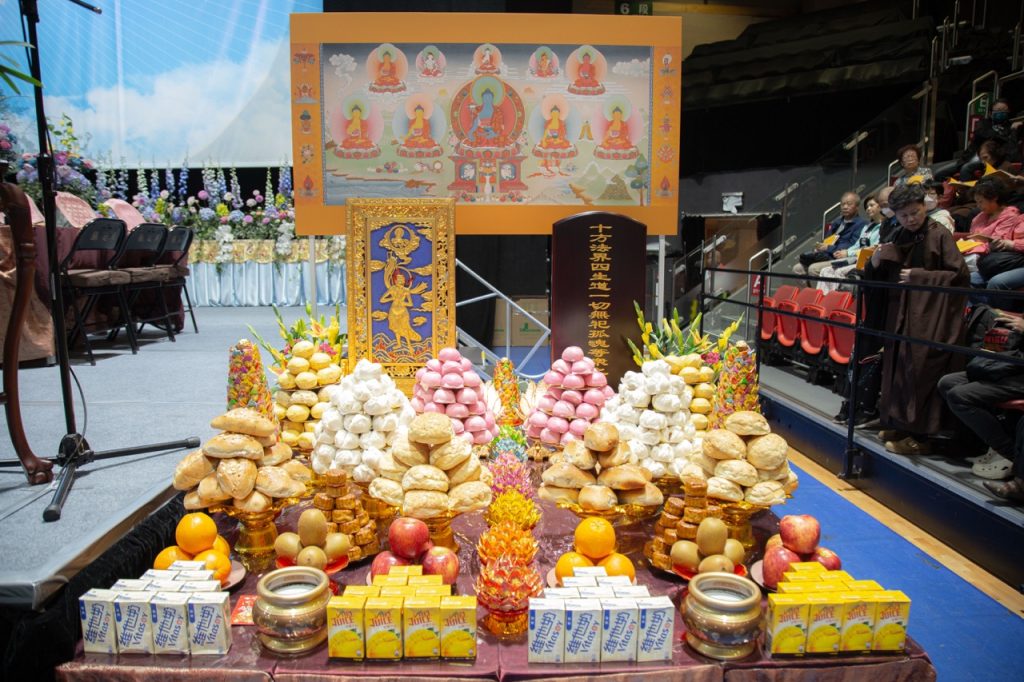
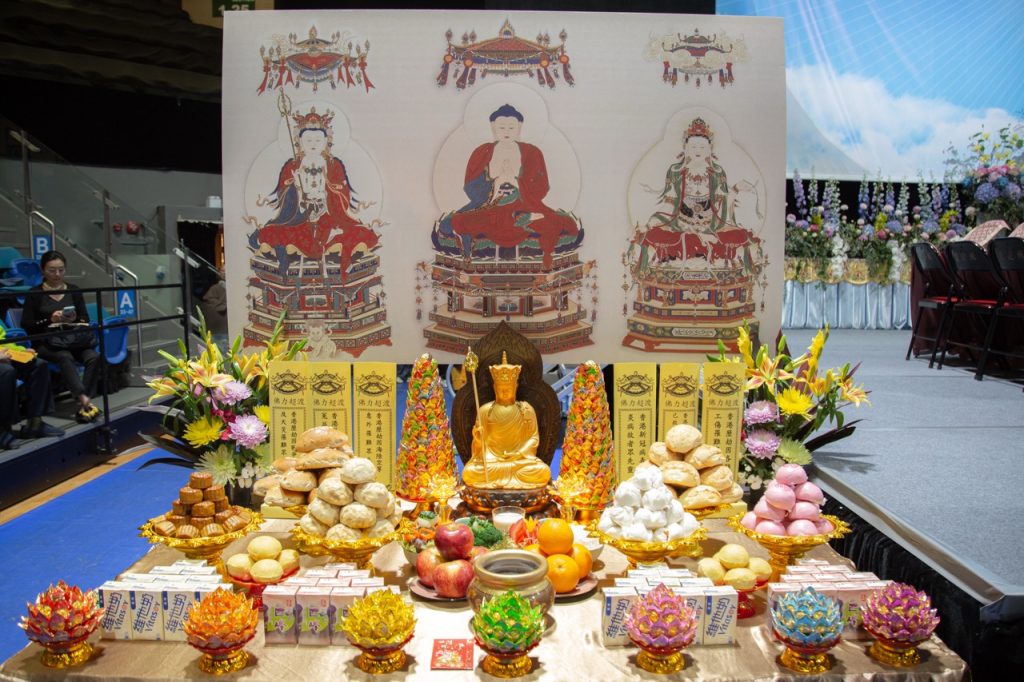
At the centre of the mandala was the Peacock Wisdom King, surrounded by the Seven Buddhas and Maitreya Bodhisattva. Banners were placed in the mandala in place of sacred images. Offerings on the altar included incense burners, peacock feathers, flowers, fruits, and vegetarian dishes, as well as milk, curds, rice, cakes, sugar, rock sugar, and honey.
Beneath the main altar were three subsidiary altars. At the center was the Dragon King Altar (Brahma Altar), inviting the Eight Classes of Devas and Nagas, Dharma protectors, and Dragon Kings to hear the sutra. On one side was the Longevity Altar, offering prayers for the living—for favourable weather, the removal of disasters, the flourishing and enduring presence of the Buddha-Dharma, prosperity and stability across all professions, physical and mental well-being, freedom from illness, social harmony, and kindness in people’s hearts.
The other was the Rebirth-Transference Altar, dedicated to the liberation of beings throughout the ten directions. It was offered especially for those in Hong Kong who lost their lives through accidents by land, sea, or air; through homicide or suicide; due to COVID-19; in the line of duty or acts of self-sacrifice; from workplace accidents; or through war, unrest, and natural disasters.
During the third day’s Mengshan Feeding of Hungry Ghosts Dharma Assembly, the atmosphere was deeply focused and solemn. When Venerable Guan Cheng invited everyone to rest and sit quietly for ten minutes, more than a thousand participants remained completely silent throughout.
Sentient beings, prone to negligence and indulgence, become attached to wealth, desire, status, food, and sleep, unknowingly creating harmful karma and falling into prolonged suffering. Only when facing its consequences do they awaken and seek deliverance. The sutra reminds us that in this Dharma-Ending Age, beings have shallow roots and weakened resolve, and must rely on the Buddha’s compassionate support to awaken their own strength. Only through diligent practice can we turn away from harmful conditions and advance on the path of enlightenment.
Venerable Shan Ci’s Brief Explanation of the Peacock Wisdom King Dharma
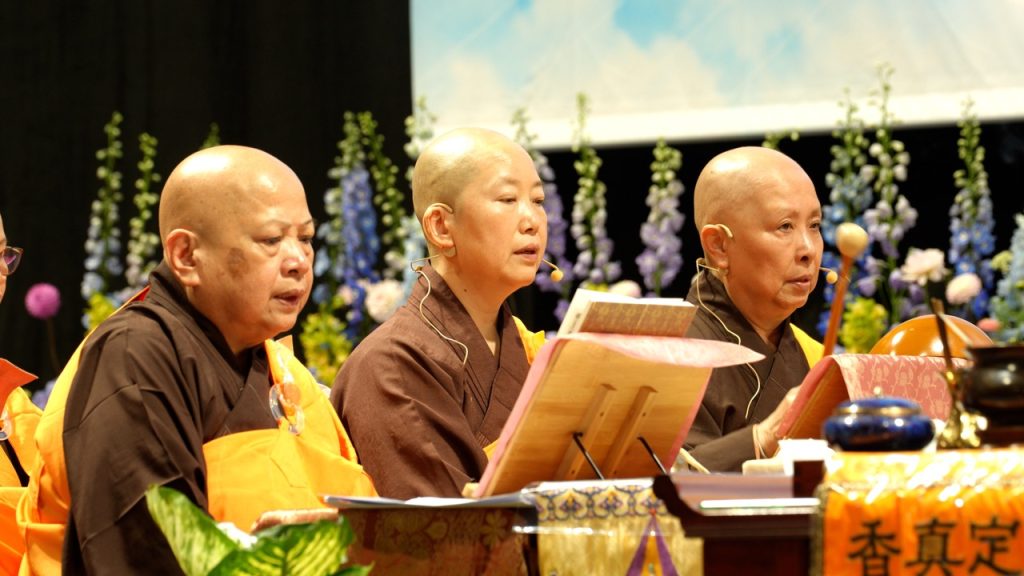
Before the Dharma assembly on November 17, we had the honour of inviting Venerable Shan Ci (pictured above, left) to offer a brief introduction to the Peacock Wisdom King Dharma and to answer questions about the sutra. Her explanation helped everyone gain a deeper understanding of both the sutra and the significance of this Dharma assembly.
As one of the four great esoteric Dharmas of the Shingon tradition, why does this sutra permit wide propagation, without requiring an empowerment (abhiseka) ritual?
In the section on dissemination in the lower volume of the sutra, the Buddha addresses this directly:
“At that time, the World-Honoured One said to Ananda:
‘For this reason, you should widely inform the four assemblies—monks, nuns, laymen, and laywomen—as well as kings, ministers, and people of the world. Encourage them to single-mindedly uphold this Dharma, teach it to others, copy the sutra, and circulate it wherever they are. They should properly establish and adorn altars, and make offerings of incense, flowers, food, and drink according to their means, so that all sentient beings may be freed from sorrow and affliction, gain immeasurable blessings, and enjoy peace and a long life.’”
From this passage, it is clear that although this sutra belongs to the esoteric teachings, Shakyamuni Buddha expressly instructed that it be widely propagated—taught to others, copied, and circulated wherever possible. This openness to broad transmission is rare among esoteric scriptures and is one of the distinctive features of this sutra.
As for the empowerment ritual, Elder Jianru repeatedly emphasized, “Attending the Dharma assembly itself is empowerment.” This is because the sutra includes an Invocation that already contains the full meaning of empowerment. By reciting the refuge portion of this invocation, practitioners take refuge in the Vajra Master, as well as in the Buddha, the Dharma, and the Sangha.
During the Dharma assembly, there is a presiding master upon whom practitioners rely. With sincere hearts, as the mandala is established and its boundaries sealed, the necessary invocations and offerings are all present. This includes the principal Vajra Master and the many Bodhisattvas and Dharma protectors within the mandala, meaning that the essence of empowerment is already complete.
The Invocation in this sutra invites spirits, devas, dragons, and celestial beings to take refuge in the Three Jewels, to listen as the sutra is recited, and to accept offerings of incense, flowers, food, and drink. We pray that they set aside harmful intentions, give rise to compassion, and generate a pure and joyful mind before the Buddha, the Dharma, and the Sangha. Together with everyone present, they join in reciting the sutras and mantras in shared harmony. When devotees attend the Dharma assembly for collective practice, they are able to receive both the ritual transmission from the master and the deeper meaning of the Dharma.
What merits arise from practicing the Peacock Dharma, in worldly and transcendental terms?
In worldly terms, practicing the Peacock Wisdom King Dharma can help dispel natural disasters and human calamities, bringing favourable weather and peace for all beings. On a personal level, one may seek the protection of Buddhas, Bodhisattvas, and benevolent beings, helping to remove physical and mental toxins, as well as inner and outer afflictions. In this sense, the Dharma can heal illness, neutralize poisons, and remove obstacles.
Beyond this, it also offers transcendental benefits. All obstacles arise from the three poisons of greed, anger, and delusion. This sutra draws upon the virtuous power of many Buddhas and Bodhisattvas to support practitioners on the path of liberation, and ultimately to help them attain rebirth in the Western Pure Land.
Elder Jianru wrote in A Guide to the Buddha Mother Great Peacock Wisdom King Sutra:
“The Peacock Dharma not only brings support in worldly matters, but also strengthens all transcendent practices. For Pure Land practitioners in particular, adding the Peacock Dharma is like having an assurance of rebirth in the Pure Land.”
Many Buddhists already have a primary practice. Can the Peacock Dharma be taken as a supplementary practice, and how should one allocate time for it?
The Peacock Wisdom King Dharma is meant to be practiced as a supplementary method. Regardless of one’s main Dharma practice, the Peacock Wisdom King provides a form of supportive empowerment. This empowerment does not replace the main practice, but offers strong assistance. In essence, all afflictions and obstacles arise from greed, anger, and delusion, leading to unwholesome actions and suffering.
The Peacock Wisdom King Dharma has an especially strong power of removing toxins. The sutra brings together Buddhas, Bodhisattvas, and practitioners of many kinds, manifesting great and extraordinary support. Through these causes and conditions, obstacles are removed and heavy karmic results are lightened. With such support, practitioners are better able to settle firmly into their Pure Land practice and diligently recite the Buddha’s name. In this way, the Peacock Dharma helps practitioners advance more swiftly in their primary path of cultivation.
How one balances primary and supplementary practice depends on one’s use of time. For example, if one’s main practice is to spend an hour reciting a sutra, one may also add the Peacock Wisdom King Heart Mantra as a supplementary practice to help remove obstacles. Reciting the entire Peacock Wisdom King Sutra may take considerable time, and when time or conditions do not allow, one can instead focus on reciting the Peacock Wisdom King Heart Mantra.
Setting aside about fifteen minutes a day to form the mudra and align body, speech, and mind is already very effective. If even ten minutes at a time is difficult, the recitation may be divided into two five-minute sessions. Whether walking, standing, sitting, or lying down, one can recite the mantra.
In coordinating body, speech, and mind—forming the mudra, reciting the mantra, and focusing the mind—the mental aspect is to visualize the light of the Peacock Wisdom King flowing from the crown of the head through the entire body. Unwholesome elements are imagined as dark water leaving the body through the soles of the feet. One may also place a mantra wheel of the Peacock Wisdom King Heart Mantra on objects where harmful influence is felt, such as a phone or a water bottle, to purify them.
Why does this sutra frequently mention supernatural beings like mountain spirits, tree spirits, and river spirits?
This sutra frequently mentions mountain spirits, sea kings, and Dragon Kings, which is a distinctive feature of the Peacock Wisdom King Dharma. Across the upper, middle, and lower volumes of the Peacock Wisdom King Sutra, all classes of devas, dragons, and spirits are invited to gather together. Through the rituals of the Dharma assembly—from praising and making offerings to the Buddhas and Bodhisattvas, to guiding practitioners to reflect on past unwholesome actions—they hear the Dharma, recall their original vows, and together protect those who practice the Buddha Mother Great Peacock Wisdom King Sutra.
Some of these beings were once malevolent spirits, harbouring harmful intentions toward others. Through the compassionate power of the Buddha-Dharma, they set aside violence, give rise to great compassion, and transform unwholesome intentions into wholesome ones. During the Dharma assembly, the sincere and reverent recitation of sutras and mantras creates shared karmic connections between the assembly and devas, spirits, and unseen beings through joint practice of the Dharma.
In this process, past grievances may be resolved and old karmic ties released. Hearing the Dharma gives rise to joy, and harm is transformed into protection. This spirit of transcending divisions between good and evil, and inviting all beings to practice together, reveals the true meaning of compassion and reminds us of its power.
There are many Chinese translations of this sutra, as well as Tibetan versions. When Professor Lin Guangming’s team carried out textual collation, they carefully compared the Sanskrit and Chinese texts and found differences between them. In particular, the Sanskrit text includes references to the “Great Tree Spirits,” which are absent from the Chinese translation. Further comparison showed that the Tibetan translation also contains these references.
Out of respect for the integrity of the various textual traditions, scholars do not alter scripture lightly. However, after careful consideration, Elder Jianru and Professor Lin Guangming reflected on the many natural disasters and illnesses facing the world today, closely linked to climate change, excessive deforestation, and the loss of tropical rainforests. Moved by compassionate care for the Earth and humanity’s well-being, and considering the fact that both the Sanskrit and Tibetan texts include the Great Tree Spirits, they agreed to translate this passage from the Sanskrit and restore it to its corresponding place in Amoghavajra’s Chinese translation.
Sharing Experiences of Spiritual Response From Practicing This Sutra
Why does the Peacock Dharma have a reputation for swiftly removing obstacles and bringing tangible benefit? There are many reasons. So long as one practises with sincerity and directs one’s mind toward wholesome aspirations, the Peacock Dharma will help bring those aspirations to fulfilment. Over the past twenty years, the Venerable has personally witnessed many truly incredible instances of spiritual response.
In practicing the Peacock Dharma, bodhicitta should be taken as the cause, compassion and skillful means as the foundation, and sincere, reverent recitation as the gateway. When practitioners focus on cultivating body and speech, together with clear understanding of the mind, responses can arise with remarkable swiftness.
Over twenty years ago, before Venerable Shan Ci had entered monastic life, she encountered a man in his early thirties. He stood before the Buddha, gesturing wildly and speaking incoherently. Many assumed that he was possessed or suffering from mental illness, yet he himself understood the cause.
After graduating from university, he took a position at a financial firm, where he earned a high salary advising his employer on business strategies. Some of these strategies, however, caused harm to others. Over time, he found himself unable to concentrate at work, and was eventually given an extended leave of absence by the company.
Later, when Elder Jianru came to Hong Kong, he spoke with the young man and gently urged him to repent with sincerity and to practice this Dharma, explaining that improvement would take some time. Through encountering the Buddha-Dharma, the young man came to understand the law of cause and effect. He repented deeply, resolved to cultivate the path, and dedicated all the merit of his practice to other sentient beings.
A few years later, he was seen again—clear in spirit and healthy in demeanour. He had fully recovered. Although he now earned less than before, his mind was at ease and his conscience unburdened. Similar responses have also been observed among others who practiced this Dharma when facing illness or unexpected adversity.
How and Why Did Elder Jianru Devote Himself to Promoting This Sutra?
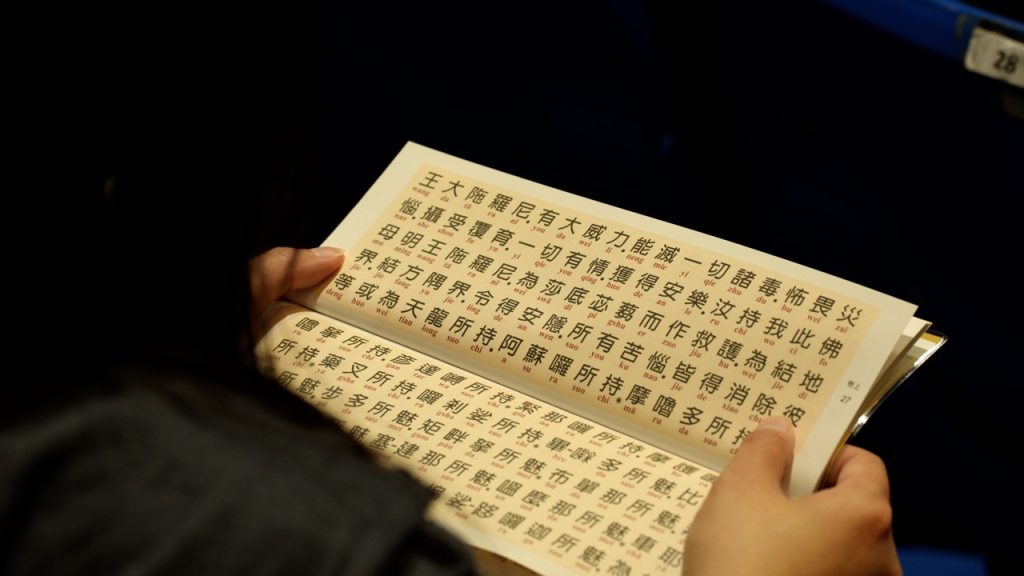
I once asked Elder Jianru, “The Buddha taught eighty-four thousand Dharma practices. Why did you choose to focus on the difficult practice of the Peacock Dharma, and devote yourself so tirelessly to studying and promoting it?”
The Elder replied with heartfelt sincerity:
“Beings in the Saha world suffer greatly. Today’s world is filled with natural disasters, human-made calamities, strange illnesses, and epidemics. The Peacock Wisdom King Dharma directly addresses these present-day problems. To liberate sentient beings, one cannot seek comfort or ease. We have simply persisted, continuing to promote this Dharma. Without realizing it, nearly thirty years have passed for us to achieve this small measure of results. That is still not enough. You, too, must give rise to great vows to help propagate this sutra.”
In his younger years, Elder Jianru had no computers to assist his work. Each time he studied and analyzed this sutra, he had to bring out many books and scriptures; his effort was so intense that it eventually ruined his eyesight.
In this Dharma-Ending Age, marked by many natural disasters and human suffering, it is all the more important to promote this Dharma. For Venerable Shan Ci, who was ordained in the West, spreading this teaching has not been easy. Translation presents real challenges, and the mantras themselves are long. Therefore, she hopes that more people will come to know this sutra and help to promote it.
What is the “Unbroken Sutra Sound Altar” in practicing the Peacock Dharma?
The “Unbroken Sutra Sound Altar” has a clear historical source. In the history of the Peacock Dharma, there was a great master of the twentieth century, Master Chisong, who played a key role in the revival of Tang Esoteric Buddhism. He was among the earliest outstanding Chinese practitioners to travel to Japan to study esoteric teachings.
After returning from Japan with the long-lost Vajradhatu and Garbhadhatu teachings, Master Chisong travelled widely across the country, holding Dharma assemblies and reviving esoteric practices. Among all the rituals he conducted, the one he practised most frequently was the Buddha Mother Great Peacock Wisdom King Sutra. During these assemblies, he also established an “Unbroken Sutra Sound Altar.”
The method involved twenty-one monastics taking turns in groups of three. Each group recited the sutra for one hour, rotating continuously so that the recitation of the Buddha Mother Great Peacock Wisdom King Sutra never ceased until the assembly concluded. This practice is also recorded in the Ritual Manual for the Painted Image Mandala of the Great Peacock Wisdom King, translated by Master Amoghavajra and preserved in the Taisho Tripitaka (T.983A).
In recent years, the Peacock Wisdom King Temple in Taiwan has revived this practice, conducting a seven-day “Unbroken Sutra Sound Altar.” The Venerable has personally participated and found it exceptionally solemn and inspiring, with benefits beyond measure.
Venerable Shan Ci’s Message to the Readers
The Peacock Wisdom King Dharma has incredibly strong powers for neutralizing poisons. This sutra brings together Buddhas, Bodhisattvas, and practitioners of many kinds, revealing a profound and powerful supportive force. Through the conditions of practice, it helps remove various obstacles; at the very least, heavy negative consequences can be borne more lightly.
The fact that we are able today to learn this Peacock esoteric Dharma—lost for over a thousand years—is thanks to Elder Jianru’s lifelong compassionate vows and the devoted efforts of many eminent Buddhist masters, who worked tirelessly to restore this teaching to the world. The sutra teaches us that greed, anger, and delusion are the three poisons of the world. We should therefore take this as a warning, reflect on our past unwholesome actions, and cultivate sincere self-awareness.
Venerable Shan Ci encourages everyone to take the Peacock Wisdom King Sutra as a supplementary practice and reap its great benefits. Elder Jianru repeatedly emphasized that this sutra does not replace one’s primary practice, but empowers and supports it. Through the merit of recitation and the protective power of the devas and Bodhisattvas described in the sutra, one’s main practice can proceed more smoothly.
For example, if one’s primary practice is Pure Land cultivation and one wishes to practice without hindrances, one may rely on the Peacock Dharma’s detoxifying power to dispel calamities and remove obstacles. Setting aside just ten minutes a day is enough. Whether walking, standing, sitting, or lying down, reciting the mantra brings only benefit and no obstruction. It is a practical Dharma method that can be easily integrated into daily life, allowing its benefits to unfold naturally.
As practitioners of the Buddha Mother Great Peacock Wisdom King Sutra, we should not seek good results only for ourselves. We should also help to propagate this Dharma—not merely for personal peace, but to share it widely, support those in need, and relieve the suffering of sentient beings. We dedicate the blessings and wisdom we cultivate to all beings, so that together we may advance on the path to Buddhahood.
Postscript
We offer our heartfelt gratitude to Elder Jianru for his long-standing guardianship and compassionate care of the Peacock Wisdom King Dharma. We are also deeply thankful to Venerable Guan Cheng for his leadership, and to all the monastics whose collective efforts brought this Dharma assembly to completion. We commend Venerable Shan Ci for more than twenty years of perseverance and dedication, resulting in A Gentle Explanation of the Peacock Wisdom King Esoteric Dharma—a fine work that brings together historical sources, personal cultivation experience, and practical guidance for practice. Through this work, a broader field of compassion and wisdom is opened, allowing us together to dispel calamities for self and others, protect life and safeguard the nation, and widely cultivate fields of merit.
Through this work, a broader field of compassion and wisdom is opened, so that together we may dispel calamities for both self and others, protect life and safeguard the nation, and widely cultivate fields of merit.
