Translated By Tony Qin
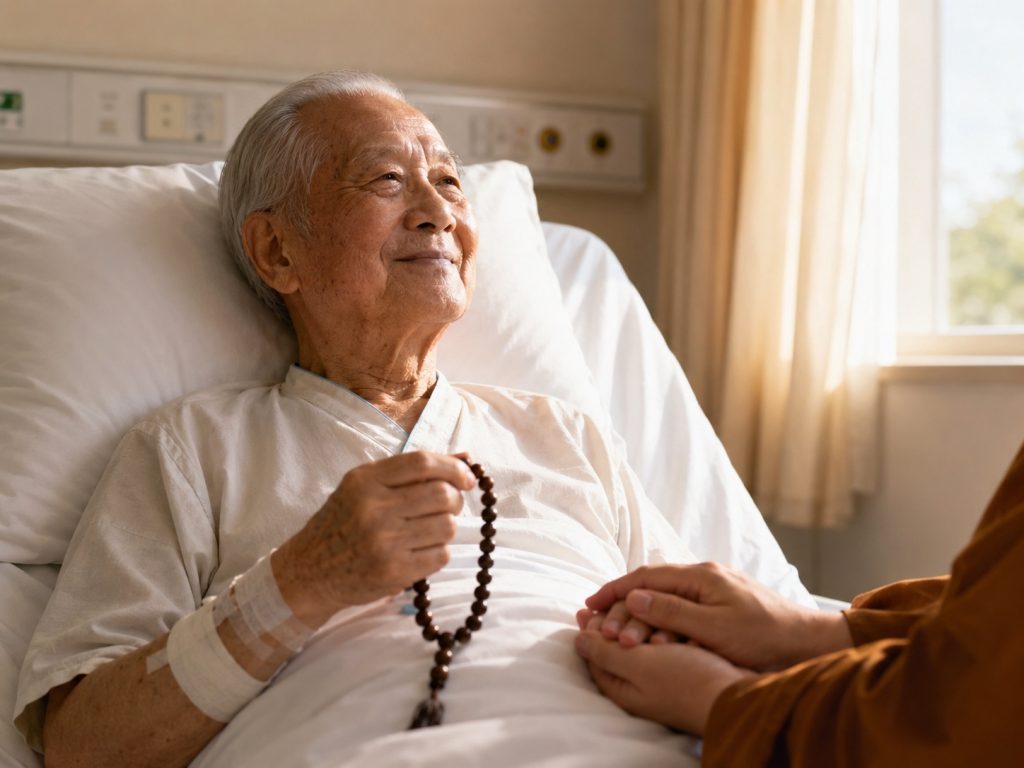
One day, I entered a hospital ward and saw a patient lying quietly in bed. His chest and limbs were wrapped in bandages. I approached to greet him and learned that his name was Yuan Jin. He was seventy years old.
He told me that while crossing the street, he had hurried to avoid being caught by the red light and accidentally fell. Not only were his arms and legs fractured, but a piece of wood by the roadside had pierced his chest. His injuries were severe, and he was rushed to the hospital for emergency treatment. After undergoing two surgeries, the doctors said that his condition had stabilized and that he was now waiting to recover.
Yuan Jin was deeply grateful to the kind passersby who had called for help in time. Otherwise, he said, the consequences would have been unimaginable. He was also sincerely thankful for the attentive care of the doctors and nurses. As we spoke, I could feel his optimism and openness of heart. Though he had endured great pain, he voiced no complaint. Instead, he kept expressing gratitude. Seeing that he had only recently come out of surgery and needed rest, we spoke briefly and then I took my leave.
During my next several visits, his recovery progressed well. Out of caution, the doctors also conducted further examinations of his other organs and confirmed that nothing serious was wrong. Because the surgery had been major, he needed to remain in the hospital for some time. During that period, I noticed that no relatives or friends ever came to visit him. When I asked about his family, he merely shook his head and fell silent.
Whenever I came to see him, he would show a rare and heartfelt smile. He listened especially attentively whenever I shared the Dharma, and his interest was sincere. One day, he asked me earnestly, “Venerable, I very much want to learn Buddhism. But I come from a humble background, and I never had the chance to go to school. Would you look down on someone like me?”
I could not help but smile. “How could I?” I replied. “The Buddha’s teachings are rooted in compassion and equality. There is no distinction of high or low, noble or poor. The Buddha guides those who have affinity with the Dharma. Since you have the wish to learn, that itself is a precious affinity. Let us study together.”
I gave him a few introductory Buddhist books and also taught him to recite, “Namo Avalokiteśvara Bodhisattva.”
More than a month after the surgery, his wounds had fully healed. Further examinations showed no major problem, only a few minor ailments for which the doctors prescribed medicine. They told him that he could be discharged in the coming days. By then, Yuan Jin’s complexion had become healthy and rosy, and he had even put on some weight since I first met him. I was genuinely happy for him and smiled as I congratulated him on soon leaving the hospital.
To my surprise, his expression dimmed. He lowered his head and fell silent.
Concerned, I asked whether something was troubling him.
After a while, he said softly, “Venerable, I do not want to leave the hospital… I am homeless. When I was young, I went down the wrong path. I picked up bad habits, refused to work properly, and in the end even my family no longer wanted me. These past years have been very hard. I have regretted it for a long time, but I have nowhere to go.”
He raised his head. His eyes were filled with helplessness and sorrow.
“Here in the hospital, I have a place to stay. Someone takes care of me. I have three meals a day. People speak with me, ask how I am feeling, and show concern for me… These have been the happiest days of my life. Now that I am being discharged, I truly do not know where to go.”
Hearing this, my heart ached. Though I understood his suffering, I could not change the course of his life. I could only turn to Ms. Lee, the hospital social worker, and ask whether anything could be done. She told me that cases like Yuan Jin’s were not uncommon. Yet many homeless individuals lacked complete identification documents, making assistance difficult to arrange. Still, she said, they would do their best.
A few days later, I returned to visit Yuan Jin again. His hospital bed was empty. He was nowhere to be found.
I stood quietly before the vacant bed and offered a silent blessing: may all be well with him.
Postscript
There is an old saying: “If one does not work hard in youth, one will grieve in old age.” Yuan Jin’s life leaves us with a deep sense of sorrow. In his younger years, he did not know how to cherish his life and allowed time to slip away. Only in the twilight of old age did regret awaken, yet by then there was little he could do to turn back.
The brief peace and care he received in the hospital may have been a mercy granted to him amid a difficult life.
I could not change his fate. I can only record this encounter and hope that readers may take it to heart. While youth and strength are still with us, may we walk each step of life carefully and plant bright, wholesome causes and conditions for the future.
