Translated By Tony Qin
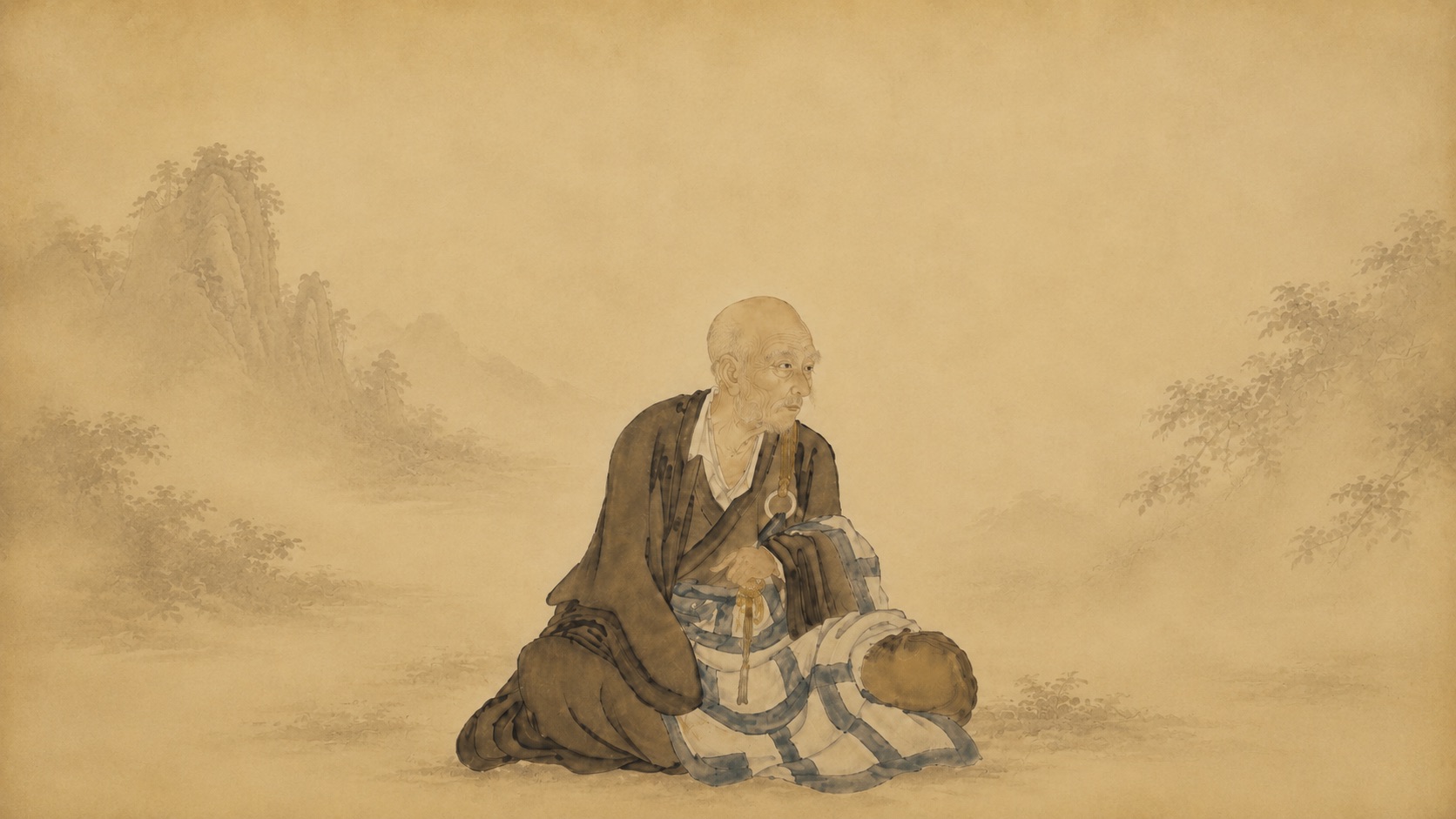
Chan (Zen) Master Lingche of the Song Dynasty wrote a poem titled In Reply to a Student Monk:
A monk once asked me what the Patriarch brought from the West;
I replied, for seven or eight years I have dwelt in the mountains.
My straw sandals have but three cords remaining,
And my hemp robe has been mended twice at the shoulders.
From the eastern hut I often see snow on the western hut;
The lower stream ever flows from the upper spring.
After midnight, when the white clouds have dispersed,
A full moon arrives at the window.
“What the Patriarch brought from the West;” refers to a well-known Chan koan.
In the Tang dynasty, a monk once asked Master Zhaozhou, “What did the Patriarch bring from the West?” In other words, what is the essence of the teaching that Bodhidharma, the first Chan Patriarch, brought from India?
Zhaozhou answered, “The cypress tree in the courtyard.”
The monk had asked the question hoping to receive a Dharma teaching—he wished to find the “gate of entry into the Path” to realize his own Buddha-nature. Yet Zhaozhou’s answer, “the cypress tree in the courtyard,” seemed completely unrelated. Was Zhaozhou simply evading the question? Not at all. His words were meant to cut through the disciple’s tendency toward conceptual seeking and grasping, thereby awakening his intuitive insight.
We must remember that the Buddha himself spoke for forty-nine years, yet declared, “I have never spoken a single word.” If we become attached to conceptual thinking and attempt to seek or acquire the Dharma through words and ideas, we become what the Chan masters call “disciples of intellectual understanding”—those who talk about food but never eat, and thus never taste true realization.
So what, then, did the first Chan Patriarch Bodhidharma bring from the West? The Chan tradition teaches “a transmission outside the scriptures, directly pointing to the mind.” But the monk, clinging to appearances, was seeking meaning in words and doctrines. Zhaozhou’s reply, “the cypress tree in the courtyard,” was a direct reminder: do not search outwardly for some distant “meaning from the West.” True realization is found within one’s own mind. What you see before you—the cypress in the courtyard—is the living manifestation of the Way.
In the same way, when Master Lingche answered, “For seven or eight years I have dwelt in the mountains,” his reply carries the same spirit as Zhaozhou’s. In other words: the simple, quiet, and untroubled life I live in these mountains is precisely the Way. The essence of Chan lies in living and practicing directly within the circumstances before us, without striving for something lofty or remote. This is the meaning of “the ordinary mind is the Way.”
“My straw sandals have but three cords remaining,
And my hemp robe has been mended twice at the shoulders.”
Here, the Master describes his worn straw sandals and patched hemp robe—symbols of a life of poverty and simplicity. Yet such simplicity is rich in Dharma joy, for it is a life of unburdened contentment.
From the eastern hut I often see snow on the western hut;
The lower stream ever flows from the upper spring.
Dwelling in the eastern hut as snow drifts all over the mountain, if one looks out the window, all one would see is the snow settling on the western hut. Though the two huts stand apart, the snow that falls is the same—it knows no east or west. Yet, a person sheltered in the eastern hut sees only the snow gathering on the western hut.
This is an allegory reminding us not to pass time in vain by always seeking fulfillment outwardly, but to turn inward to discover and cherish the innate treasure within our own heart.
The next line, “The lower stream ever flows from the upper spring,” teaches that the source of both is one and the same—the water that flows above and below arises from a single spring. This is an allegory for the pure and indivisible nature of True Suchness, which flows like a spring, free from all distinctions. Yet to the deluded mind, notions of “upper” and “lower,” “self” and “other” arise in opposition. If one were to abandon such discriminations and observe reality as it truly is, one would see that these differences are merely varied expressions of the same current. When we trace the flow back to its source, could any real distinction be found?
From this we see that when beginners observe the snow and water, they give rise to distinctions between self and other, this and that. Such conceptual discrimination prevents them from awakening to the truth.
How, then, does one awaken? The final verse reveals the answer:
After midnight, when the white clouds have dispersed,
A full moon arrives at the window.
In the stillness of night, when the white clouds drift away, the bright moon illuminates the sky, casting its light across the quiet meditation hut. Gazing out the window, one beholds the serene, radiant moon—clear, pure, and boundless—its stillness pervading the silent earth. In that moment, all worries dissolve, and the mind becomes as luminous and tranquil as the moon itself. Subject and object vanish into oneness. This is a realm beyond the reach of words—just as the poet Hanshan wrote:
“My mind is like the autumn moon,
Clear and bright upon the jade pond.
Nothing can compare with it—
So how could I ever express it in words?”
Dear readers, the white clouds symbolize the afflictions of sensual attachment, while the bright moon represents the Great Treasury of Radiant Illumination. When the clouds of delusion are swept away and the moonlight of True Suchness fills the window, it signifies the realization of the innate radiance of the Tathāgatagarbha—the Buddha-nature inherent within all beings.
