In the hospital ward, I saw a gentle-looking elderly man lying in bed, quietly scrolling through his phone. When he noticed that a monastic had come to visit, he immediately took out an electronic writing tablet and slowly wrote, “I have ALS.” I knew that ALS is an irreversible neurodegenerative disease, and it seemed he could no longer speak. At that moment, a deep sadness welled up in me.
We communicated briefly through the writing tablet. I learned that his name was Lai Jun, that he was seventy-five, and that his illness had begun early the previous year. He could no longer speak, but he could still hear and was still able to respond in writing. He told me that he was a Buddhist, then opened the Heart Sutra on the internet and asked me to recite it for him at his bedside. As the sound of the sutra filled the room, he suddenly broke down, overcome with emotion, and began to sob.
I wiped away his tears and wrote another question: “What is still weighing on your heart?” He replied that he understood his illness in light of the Buddhist teaching of cause and effect. He was not crying because he feared pain. He simply did not want his illness and suffering to burden his family and friends, or make them worry and exhaust themselves on his behalf. He could not bear to see the pain and grief he was causing them…
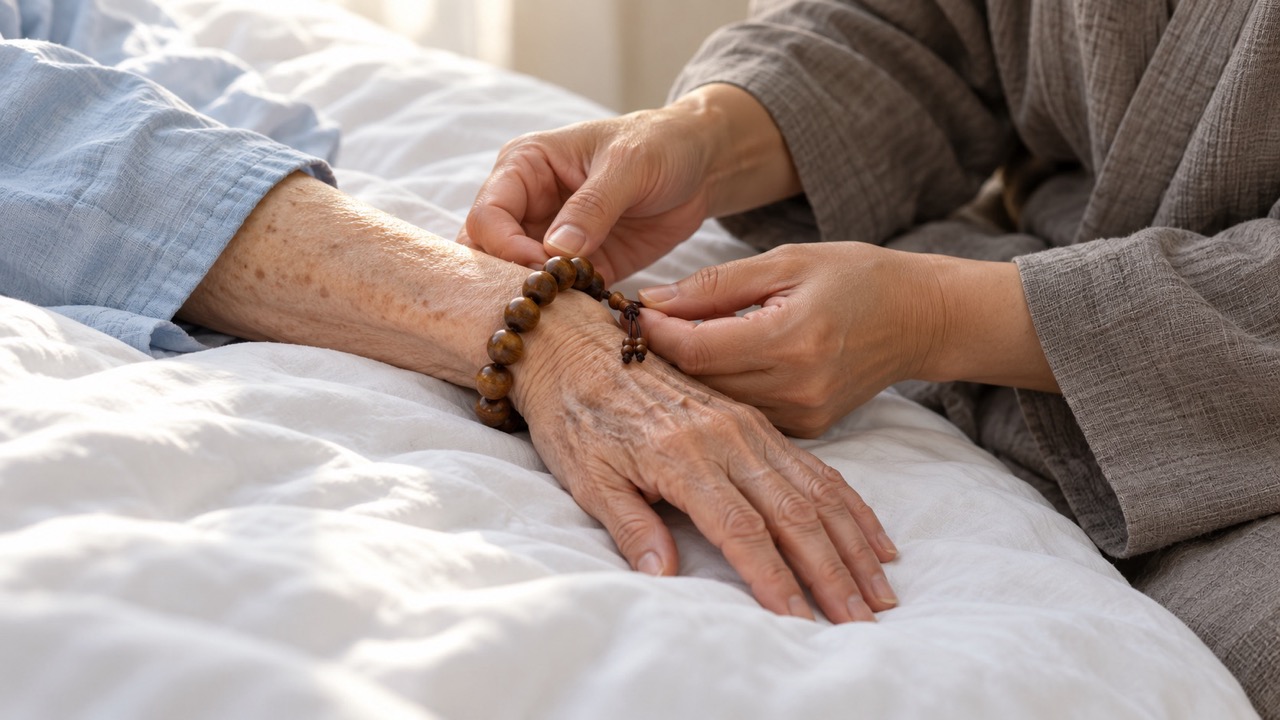
I could see that he was carrying so much concern for others that his heart could not find peace, and at first I did not know how to ease his worries. I gave him a string of prayer beads and tied them around his wrist. Then I leaned close and said softly, “Would you do something for me? Try turning your worry for your loved ones into gratitude. Be grateful for the deep love they have given you, and think of them with that gratitude. Would you do that?” He nodded, and gradually calmed down. “Get some rest,” I said. “I’ll come and see you again in a few days.”
Two days later, I returned with a volunteer. He looked well and greeted us with a smile. “Are you feeling a little better?” I asked. He raised his hand, the prayer beads still around his wrist, and gave us a thumbs-up. I continued writing to him: “I understand how much you are suffering. But in the end, every one of us has to pass through birth, aging, illness, and death. Who can escape them?” Tears welled in his eyes again. I could not tell what was going through his mind at that moment.
The volunteer and I recited the Heart Sutra again by his bedside and chanted the sacred name of Avalokitesvara Bodhisattva. About fifteen minutes later, we resumed our conversation. He wrote, “Body and mind are both suffering. These are my own karmic obstructions. No one else can take them away for me. In the end, I have to bear them myself.” His handwriting had become shaky and uneven, and he was clearly exhausted. We decided to let him rest, but before leaving we reminded him, “For now, try to recite the sutra silently in your heart each day. Pray for the blessings and support of the Buddhas and Bodhisattvas, and don’t let wandering thoughts keep tormenting you.”
After leaving the hospital, I went online to learn more about ALS. Only then did I realize that Lai Jun had already reached the middle stage of the disease, when uncontrollable crying or laughter can occur. It is a symptom of the illness, not simply an emotional outburst. Although the disease gradually causes paralysis, the senses and intellect often remain unaffected, and awareness can stay clear. The volunteers and I all wanted to do whatever little we could to help him through this difficult time.
After that, his condition grew steadily worse. When we visited, he was usually asleep; on the rare occasions he woke, he no longer had the strength to write. Since conversation was no longer possible, we would sit by his bed, recite sutras, and chant the sacred name of Avalokitesvara Bodhisattva, trusting that he was still glad to hear them. Whenever the volunteers were on duty, they too would often stop by his bedside and keep him company in the same way. We all sincerely hoped that his heart might find a little ease, and that he could pass through this difficult chapter of life in peace.
What was happening in Lai Jun’s mind as he endured the suffering of his illness? We could not know. Were we truly able to help him find peace as he faced pain, illness, and even death? The truth was that there was very little we could do. We could only return to his bedside, again and again, offering our recitations and blessings as gently as we could, with the hope that somewhere in his heart he might find a refuge of peace.
Afterword
From the moment we are born, each of us must one day pass through aging, illness, and death. The Buddha-dharma teaches that “all conditioned things are impermanent.” Everything we experience in body and mind arises when causes and conditions come together, and changes as those causes and conditions change. When impermanence suddenly enters our lives, most of us feel lost and afraid. Often, the pain of illness reaches deeper than the body and becomes even harder to bear, because it can be so difficult to accept what is happening. People may find themselves swept again and again through grief and loss. How, in the midst of suffering, can we still find peace within and face adversity with acceptance? This is a profound and difficult question.
Sometimes, there is only so much others can do for us. The turning points of life are ours to face. At such times, religious faith can become a source of strength and refuge. Reciting sutras and chanting the sacred names of Buddhas and Bodhisattvas are not only about praying for the world around us to change. With each recitation, we gather the mind and let it settle. Fear can soften into awareness, worry into gratitude, and suffering into nourishment for practice. Little by little, we learn to stop resisting and to accept the passages that every life must go through. In this way, the heart may find a place of peace even in the most difficult times.
