
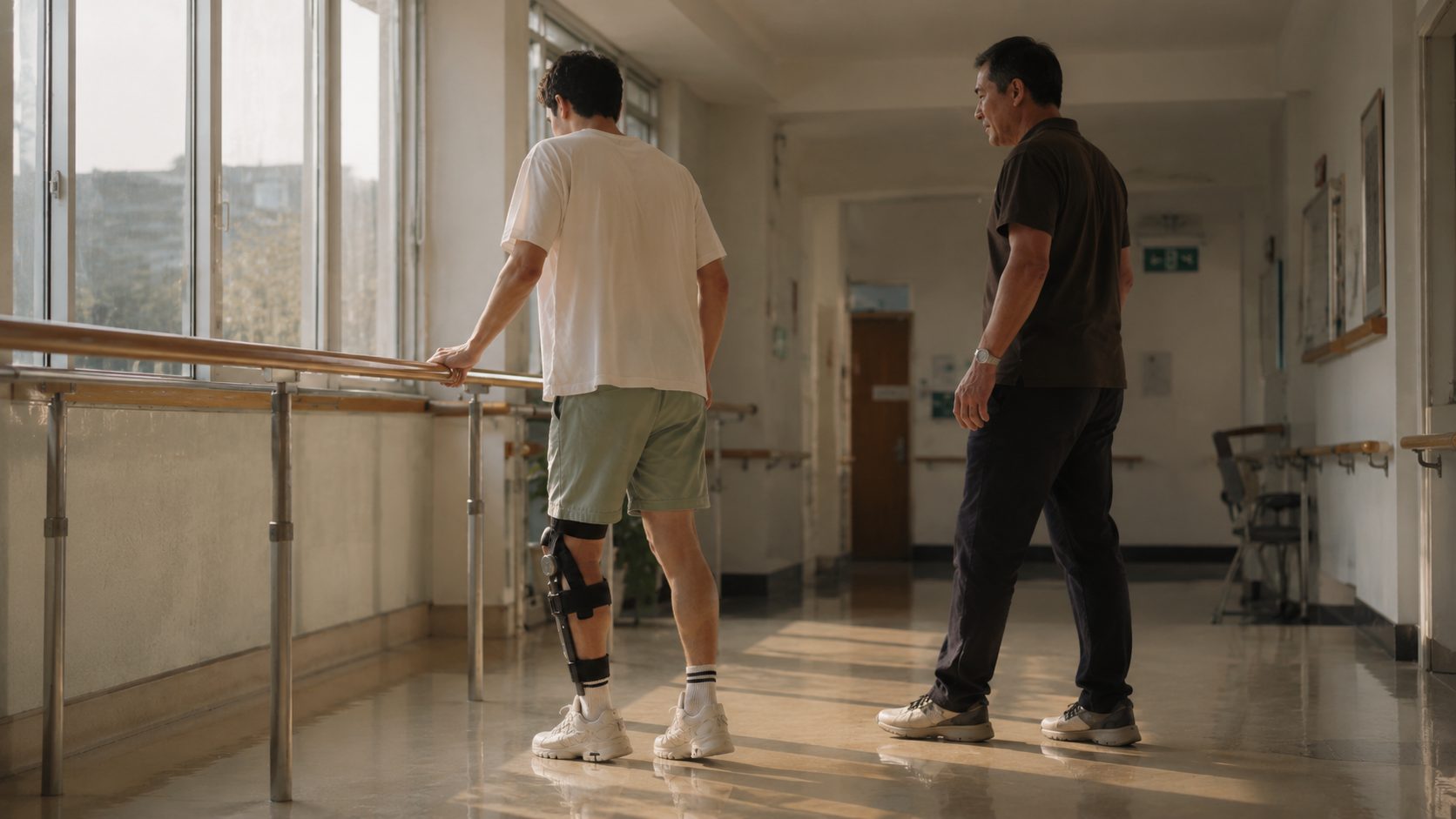
That day, before beginning our service, the volunteers and I followed our usual routine of reviewing the visitation records. One of the volunteers suggested that I visit a young patient who, I was told, had been diagnosed with a rare illness called Guillain-Barré syndrome. It is an autoimmune inflammatory disorder of the nerves, in which the body’s immune system mistakenly regards its own peripheral nerves as enemies and attacks them. This can lead to weakness throughout the body, and in severe cases, paralysis and difficulty breathing.
When I entered the hospital room, I saw a young man lying quietly in bed. His face looked somewhat worn and pale. His father was sitting beside him, deeply worried, though trying hard to remain composed. I learned that the patient’s name was Da Wei. He was only in his thirties, a successful accountant, and had already been in the hospital for more than ten days.
At that time, Da Wei’s limbs were paralyzed, and all the muscles in his body were weak. He could not even turn over or get out of bed by himself. Every aspect of his daily care depended on the help of others. He was facing an extreme sense of exhaustion and helplessness, which was painful to see.
Fortunately, his facial muscles had not been affected. He could still eat, remained fully conscious, and was able to speak.
The doctor explained frankly that the cause of this illness was unclear. Most patients need several months, or even several years, to gradually recover. Da Wei’s condition had not reached the most severe stage. As long as he cooperated actively with treatment and patiently waited for the nervous system to repair itself, there was still hope for improvement.
I spoke with him at length, trying to understand his state of mind. He admitted that when the illness first appeared, he simply could not accept such a sudden blow. His heart was filled with despair and anger, as though his entire world had collapsed in an instant. Yet under the tireless care of his family, who stayed by his side day and night, he gradually emerged from the darkness. A quiet acceptance began to arise in his heart.
He said, “Since it has already come, I should face it peacefully.”
His tone was calm, yet it carried a rare strength.
I asked him what mattered most to him at this stage. After a moment of silence, he slowly replied, “This illness has made me truly understand what impermanence means. Only when I could no longer move my body as freely as before did I begin to truly feel the love and care of my family. Only then did I have time to quiet down and reflect on my life…”
He said that in the past, he had been busy with work, rushing day and night. He always thought there would be time later to accompany his family. Again and again, he missed opportunities to travel abroad with his parents. Now, lying in a hospital bed and looking back, his heart was filled with regret and self-reproach. He was afraid that he might never have the chance to make up for it.
Da Wei also admitted that there was a Buddhist temple near his home. He often passed by it but had never once gone in to pay respect. He had once signed up for volunteer service, yet repeatedly declined because he was busy with work. He had wanted to study the Dharma more deeply, but kept finding excuses to postpone it. To this day, he had not even attended a single Dharma lecture. These plans that he had always put off with the thought, “I’ll do it when I have time,” had now become heavy regrets.
Yet Da Wei said that he had made a firm resolve. If he recovered, he would no longer waste his days. He would seize the present moment, fulfill his promises, and make up for the regrets of the past.
He said firmly, “Regret is useless. What matters most is that once I leave the hospital, I must begin doing these things immediately. Otherwise, if I miss the chance again, I will truly regret it beyond remedy.”
I praised him for his optimism, strength, and open-mindedness. To give rise to reflection and courage in the midst of hardship is truly rare. I also wished him an early recovery.
After that, the volunteers and I visited him several more times. We were glad to learn that his condition had gradually stabilized and that his neurological function was slowly recovering. About a month later, I went to see him again. From a distance, I saw him outside his hospital room, pedaling a rehabilitation exercise bike. Several young friends were gathered around him, chatting and laughing together. The atmosphere was warm and joyful, a bright scene rarely seen in that hospital.
I did not go forward to disturb him. I simply stood quietly at a distance and watched, my heart filled with joy and comfort. In that moment, I knew that Da Wei was about to begin a new journey in life.
Postscript
In the dust of the mundane world, people often rush day and night for fame, gain, and achievement, spending their preciou
