Translated By Tony Qin
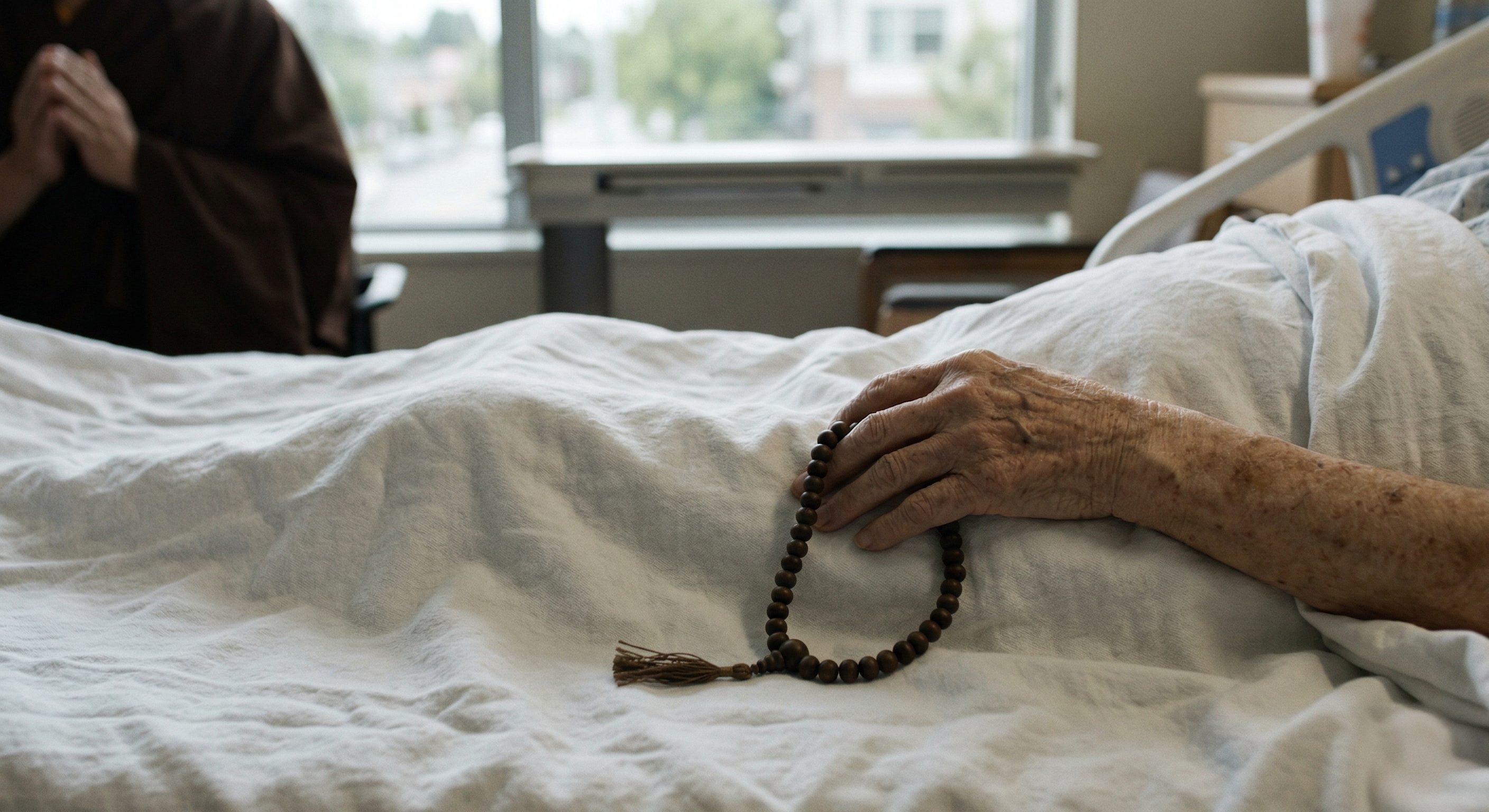
One day, our temple received a call from a nearby hospital. The family of a terminally ill patient was asking if we could come to offer chanting at the time of passing. I went together with Venerable Yuanchuan and two lay practitioners. When we arrived, Madam Chen had just passed away. With calm solemnity, Venerable Yuanchuan reminded us, “This moment is crucial for chanting.”
At the bedside sat only her daughter, Ah-Zhen. Tears streamed down her face as she gently wiped her mother’s cheeks. I softly encouraged her not to touch the body, so as not to disturb her mother’s consciousness. We gathered around the bed and began reciting the Buddha’s name with reverence.
During a pause, I invited Ah-Zhen to step outside, where she shared her mother’s story with me. Their family were Vietnamese Chinese. Madam Chen had lived to the age of ninety, raising nine children through a life of hardship. Four decades earlier, they had fled the war, during which her husband and two sons tragically perished. Today, some of the children live scattered across Canada and the United States, while one son remains in Vietnam.
Ah-Zhen described her mother as a pillar of strength and love—diligent, frugal, and devoted to her family. A faithful Buddhist, she often visited temples to bow and recite sutras. Yet her greatest concern, even at the end of her life, was the son still far away in Vietnam.
Chanting for the departed is not only about reciting the Buddha’s name—it also means offering Dharma guidance. I leaned close to Madam Chen’s ear and spoke gently:
“Madam Chen, you worked tirelessly all your life, enduring hardship and giving everything for your family. Your children are deeply grateful for your love. Now, the ties of this world have come to their natural end. Please set aside all worries, let go of every attachment, and place your mind fully on the Buddha. Journey now to the Pure Land, where there is no more suffering, only peace and joy.”
Hearing these words, Ah-Zhen grew more emotional, quietly sobbing by the bed. I gently motioned for her to step outside, so that her grief would not disturb her mother’s spirit. We continued chanting, and again I leaned in to speak at Madam Chen’s ear, explaining the Dharma of karma and rebirth.
A little later, I noticed Ah-Zhen at the doorway, weeping as she spoke on the phone. She was telling her brother in Vietnam that their mother had passed, and he, on the other end, cried uncontrollably.
She explained to me that in her homeland’s custom, if children did not wail loudly at their parents’ death, they were seen as unfilial. She wanted to place the phone at her mother’s ear, so that her brother’s cries could fulfill his duty as a “filial son.”
Hearing this, I earnestly explained:
“At the moment of death, the final thoughts are of utmost importance. If one can let go of worldly ties, release all clinging, and rest in peace, then there is hope for a good rebirth. But if emotions stir and the mind becomes unsettled, the spirit may fall into unfortunate paths. You invited us here today to help your mother find peace and a good rebirth. If loud cries disturb her mind at this critical moment, that would be the real act of unfiliality.”
Ah-Zhen was silent, thoughtful. Then she asked me to speak directly to her brother on the phone. With patience, I told him:
“I understand your grief completely. But in this moment, the greatest act of filial piety is not to cry and wail. It is to help your mother let go, so that she can leave peacefully. You should speak to her with gratitude, saying: ‘Thank you, Mother. We will live well. Please be at ease and go without worry.’”
I suggested that the siblings express their gratitude and farewell together, transforming their grief into a blessing of release. Soon, another sister arrived, and the daughters gathered by the bedside. With tears restrained, each whispered words of thanks and loving farewell.
Then they joined in the chanting. For more than an hour we recited the Buddha’s name and offered Dharma guidance. At the end, an extraordinary sight appeared: Madam Chen’s face grew soft and rosy, and a faint smile seemed to grace her lips. It was deeply moving, as though we had witnessed a serene and graceful farewell.
Before we left, the daughters bowed with sincerity: “We are deeply grateful to you, Venerables and Dharma siblings. From now on, we will study the Dharma wholeheartedly and let go of old mistaken views.”
Postscript:
In many cultures, crying loudly at funerals is seen as a sign of deep love and loyalty. Yet in truth, such emotional displays can bind the departing spirit, stirring confusion rather than release. Far from being filial, this may actually hinder a loved one’s peaceful rebirth.
True filial piety is not found merely in rituals at the time of death. It is shown while our parents are alive—by caring for them, supporting them, and ensuring their peace of mind in later years. At an even higher level, filial love means guiding them toward the Dharma, nurturing wisdom and planting the causes of liberation, so that they may be reborn in the Pure Land and be free from suffering forever. This is the path of ultimate filial piety.
