Translated By Tony Qin
—A Gift to Readers Making a Pilgrimage to Mount Jiuhua
The Gate of Emptiness is lonely; you long for home.
Having bowed farewell at the Cloud Chamber, you descend Mount Jiuhua.
You delight in riding bamboo horses beside the bamboo fence,
Yet are reluctant to gather golden sand upon the Golden Ground.
When filling your vase from the stream, do not grasp at the moon’s reflection;
While brewing tea in the bowl, do not idly play with flowers.
Go well now; there is no need for falling tears.
This old monk has mist and rosy clouds for company.
This is a farewell poem, written by Master Jin Dizang as parting words for his young attendant.
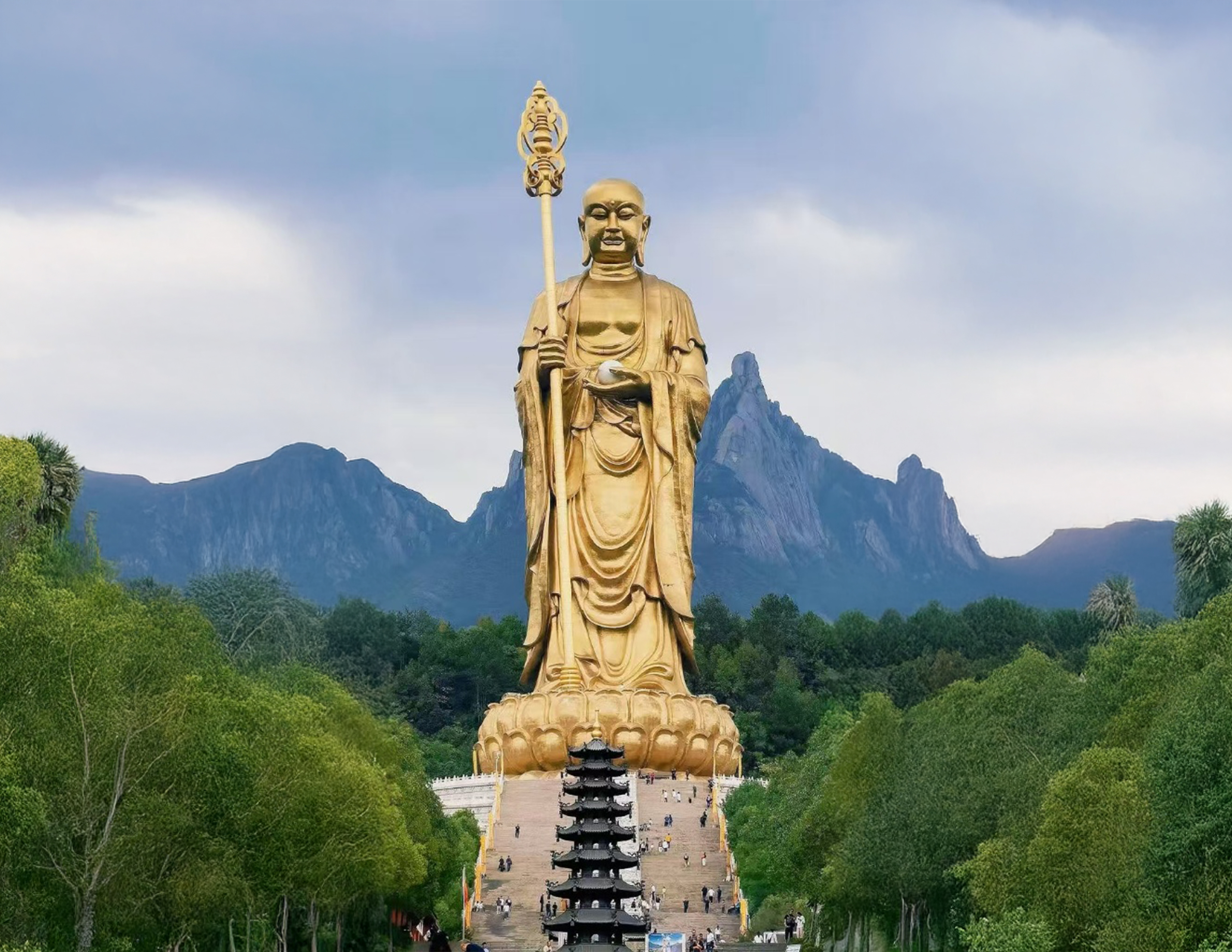
Master Jin Dizang was the founding patriarch of Huacheng Temple on Mount Jiuhua in Anhui Province, China. Within the Buddhist tradition, he is widely recognized as a manifestation of Kṣitigarbha Bodhisattva. The origins of Huacheng Temple are recorded in the Records of Mount Jiuhua, while the noble deeds of Kṣitigarbha Bodhisattva, who “manifests various bodies throughout hundreds of thousands of millions of worlds to rescue all beings suffering from karmic retribution,” are described in detail throughout the sutras (see Note 1).
According to the Biographies of Miraculous Monks, fifteen hundred years after Śākyamuni Buddha entered Nirvāṇa, a Bodhisattva appeared in Silla, present-day Korea, as a prince. His surname was Kim, and his name was Gyo-gak. He later renounced the household life, became a monk, and took the Dharma name Dizang, or Kṣitigarbha.
During the Yonghui era of Emperor Gaozong of the Tang dynasty, Master Jin Dizang sailed to Tang China to study the Buddha-Dharma. When he reached the Southern Terrace of Mount Jiuhua, present-day Shenguang Ridge, he was deeply moved by the mountain’s wondrous peaks and beautiful ridges. Finding the surroundings quiet, pure, and peaceful, ideally suited to Chan practice, he secluded himself in a mountain cave and practiced austerities for several decades.
In the early years of the Zhide era, an elder named Zhuge Jie climbed the mountain with the village elders on a leisurely excursion. When they reached this remote and secluded place, surrounded by a vast sea of clouds, they suddenly saw Master Jin Dizang sitting in meditation inside a stone cave, his eyes closed. Beside him was a broken cauldron used for cooking. Inside it were white clay and coarse rice. It turned out that for several decades, Master Jin Dizang had survived by eating coarse rice cooked together with white clay for nourishment.
Everyone was deeply moved by Master Jin Dizang’s ascetic practice. They therefore found a nearby site and built a Chan monastery for him. The monastery was completed in the second year of the Jianzhong era, and the emperor bestowed upon it the name Huacheng Temple. It became the founding temple of the Kṣitigarbha Bodhisattva sacred site on Mount Jiuhua.
When Master Jin Dizang lived alone in the cave, the village elders sent a young boy to serve as his attendant. Yet deep in the Cloud Chamber, far from human habitation, the boy could not endure the solitude and loneliness. Longing for home, he resolved to bid farewell to the Chan Master and descend the mountain. At the time of parting, however, the boy was reluctant to leave and wept repeatedly. Master Jin Dizang then wrote this poem for him as a keepsake.
“The Gate of Emptiness is lonely; you long for home.
Having bowed farewell at the Cloud Chamber, you descend Mount Jiuhua.”
In the rolling dust of the mundane world, multitudes come and go, rushing after fame and gain, as countless sentient beings eagerly pursue worldly concerns. In the mountain dwelling beyond the dust, however, the water is still, the clouds are leisurely, and all is peaceful and free from striving. How could an ordinary person, anxious and restless in worldly pursuits, easily settle into such simplicity?
The boy could not endure the loneliness of Buddhist life. Missing his family, he went to the Cloud Chamber (see Note 2) to bow farewell to the Chan Master and prepared to pack his belongings and descend the mountain.
“You delight in riding bamboo horses beside the bamboo fence,
Yet are reluctant to gather golden sand upon the Golden Ground.”
The boy was innocent and full of childlike simplicity. His childish heart had not yet faded, and he still loved the game of riding bamboo horses. Although he lived on the mountain with his teacher, his heart was still drawn to play, and he was reluctant to cultivate the supreme methods of Chan.
“Golden Ground” is another name for a Buddhist temple. The Expedient Means Chapter of the Lotus Sutra says, “Even children at play who gather sand to make a Buddha stupa…” Therefore, “gathering golden sand” in this poem serves as a metaphor for studying and practicing the Buddha-Dharma.
“When filling your vase from the stream, do not grasp at the moon’s reflection;
While brewing tea in the bowl, do not idly play with flowers.”
These two lines are the Master’s parting instruction.
“Grasping at the moon’s reflection” and “idly playing with flowers” are metaphors for attachment to fleeting appearances, which create unwholesome karma and give rise to afflictions. We should understand that in the secular world, ordinary people, in pursuit of the Five Desires—wealth, sex, fame, food, and sleep—often create unwholesome karma without realizing it. They commit killing, stealing, sexual misconduct, false speech, frivolous speech, harsh speech, divisive speech, greed, anger, and ignorance. These karmic forces bring about immeasurable afflictions and suffering.
The Chan Master was cautioning the boy that when he returned to the dusty world below the mountain, he should be careful in his conduct. He should keep his body and mind empty, serene, bright, and pure, like a clean vase filled with water. He should avoid being drawn into fleeting appearances, romantic entanglements, or frivolous conduct. He should remember his teacher’s instruction.
The entire poem contains no heavy preaching, no shout of admonition, and no sharp Chan repartee. Only these two lines offer earnest and gentle counsel. Between the lines, we see everywhere the compassionate bearing of an old Chan master.
The boy’s tears at parting revealed his sincere emotions. The Chan Master’s own emotions were as faint as the mist drifting through the mountains. Yet his care for the boy was as dense as the lush green pines.
This warm and intimate feeling is contained in the “poetic eye” (see Note 3) of the final two lines.
“Go well now; there is no need for falling tears.
This old monk has mist and rosy clouds for company.”
His meaning was this: “Return home safely, child. Do not cry. I have the green mountains as my companion and the mist and rosy clouds as my friends. I will not be lonely here.”
In truth, although the old monk’s physical body dwelt among mist and rosy clouds, his Dharma Body had long since abided in the wondrous realm of Nirvāṇa beyond the clouds.
Note 1: According to the Daśacakra Kṣitigarbha Sutra, the Sutra on the Divination of the Effect of Good and Evil Actions, and other scriptures, Kṣitigarbha Bodhisattva has manifested countless transformation bodies throughout many kalpas to deliver sentient beings. He is therefore also known as the “Thousand-Bodied Kṣitigarbha.”
Note 2: “Cloud Chamber” is an ancient term for the dwelling of a hermit or Chan monk.
Note 3: “Poetic eye” refers to the most skillful and expressive words or lines in a poem.
